Search

PO Box 2 Blackball

Paul Maunder's blog

Month

May 2016

Becoming Teflon John

They say about John Key that nothing sticks, and he looks set to become a long serving prime minister, with the opposition unable to damage his standing, or find the wedge that splits open the political middle ground.

The biography on Key produced before the last election was an informative read. We know the basic story: single Mum working at nights, state house, mediocre school student with the ambition to be prime minister, wanting to study economics but Mum saying accountancy was a better option career-wise; and the young graduate, who can’t remember noticing that great ethical battleground, the 1981 Springbok Tour, then seeing a TV documentary on currency trading and saying to himself, That’s what I want to do.

So, what does a currency trader do? The Foreign Exchange market (FX for short) exists ‘to facilitate the exchange of one currency for another’. [1] It’s necessary for multinational companies ‘who need to pay wages in different countries, buy and sell between countries and for mergers and acquisitions.’ It also means we can go on holidays in different climes and change our money at the airport. But this practical use is only 20% of the market volume. The other 80% of trading is speculative, to put it bluntly, gambling by large financial institutions and wealthy individuals, ‘who want to express an opinion on the economic and geopolitical events of the day.’ Right now, they might want to hasten the downfall of Venezuela for instance, or influence the UK referendum on whether to belong or not to the European Union.

All currency trades exist simply as computer entries. Trading involves betting one currency against another. If I think the NZ dollar will increase in value against the Aussie dollar I buy NZ dollars with Aussie dollars and after 24 hours, during which I hope the rate will have increased, I buy Aussie dollars with my NZ dollars. If the rate has increased by 1 cent in the dollar and I have risked 1 million dollars I’ve made 10,000 in a day. You can also put a forward date on the transaction, say a month’s time. If in the meantime, an election is occurring, or a budget, that would up the stakes.

Currency traders play middle men, buying the million kiwi dollars at a rate acceptable to the seller and then, in turn, buying the Aussie dollars. If there’s a differential of .2 cents, they’ve still made a couple of thousand. They’ll win some and lose some, but over a week, they’ll be wanting to make a profit. Of course, there’s research to help: past movements of the currencies and ‘fundamentals’ to take note of, namely ‘the likely effect of economic, social and political events on currency prices’.  It’s a risky business but huge gains are possible. George Soros reputedly made a billion dollars in one day. There are no rules or regulations and it is the largest financial market on earth, 3.2 trillion dollars being exchanged daily. It’s a global poker game for the wealthy.

John was good at it. Like a poker player you’d have to have confidence, an ability to read the opponent and ways of coping with stress.  Some dealers, in order to relax, opt for the high life: sniffing cocaine and taking a call girl to Acapulco for the weekend; but John married his childhood sweetheart, had a couple of kids and saved his money until he had a nest egg which would see him through.

Now for his boyhood ambition, to be PM. He’d been at the heart of the beast, accepted that that’s how the world works (a poker game for the rich) – of course, there’s other stuff going on, droughts, plagues, wars, Springbok Tours, poverty, but they’re not really important, other than their effect on currencies. I mean, don’t sweat them. When you get to be PM, watch out for the fundamentals and past movements. There’ll be colleagues who get tempted by the high life, just rein them in or get rid of them. It’s sort of fun being with celebs and being one. The opposition’s stuck in some time warp worrying about injustice and beggars and people sleeping in cars and stuff, but it’s not actually relevant – the FX is where it’s happening and people know that. Life’s a poker game, a celeb game, everyone wants to be wealthy enough to not have to worry. And they’re all waiting for the chance, waiting for the button to push. Apartheid went away didn’t it? Making a song and dance didn’t do much. The exchange rate did them in. The wealthy said, Whoa boys, it’s not working any longer. So stop the ethical sweating. It’s a waste of energy.

Of course, as PM you have to take notice of what people are thinking. For that, you’ve got the polling. If they’re really against something, got some bee in their bonnet, well, don’t do it. Doesn’t matter. Win some, lose some. Don’t get into a sweat at the occasional loss. Just keep on eye on the fundamentals. And know that incremental change is worthwhile – the FX operates to the fourth decimal point.

And everyone agrees, really. Is Labour against the FX? Nah. The Greens? Nah. So what are they on about? Trying to sweat the little stuff – workplace laws, environment – stuff like that. Of course, as you move around you do see some shit that makes you think. Syria, ISIS, people who’ve lost the plot, gone sort of primitive, dog eat dog, blood and guts. What war must have been like. Before drones. But the FX’ll sort it out. I mean, it’s dog eat dog, but doesn’t involve fists or rocket launchers. It’s civilised. The only problem is if someone starts attacking that. This Sanders bloke is a bit of a worry, but he’ll go away. Thank God we haven’t got anyone like him in this country.

Right, got to get on the plane again. My daughter’s got a graduation in Paris. Better head off for the weekend. You know, if you’re really smart, you can create a bit of a dynasty. Not bad for a kid from a state house.
[1] https://en.wikipedia.org/wiki/Foreign_exchange_market

Walking in the rain

It’s pissed down for two solid weeks, unusual, even for the Coast. We’ve experienced all the varieties: showers, steady rain, squally rain, pouring rain, heavy rain, bucketing rain, plus hail, big winds, lightning and thunder. Occasionally, patches of blue sky have appeared, to be quickly covered by a new front coming over the Paparoas.  The river is a majestic khaki torrent, but there’s no flooding – the land is skilled in shedding water.

We’ve got a dog, Whaea has two, and it falls on me to give them their daily exercise, rain or no rain. I wear the appropriate jacket and leggings for the type of rain being experienced  – the old stiff yellow plastic remains the most watertight – and drive the dogs up to the edge of the rain forest, which basks comfortably in this wetness, park and begin walking up the Croesus Road. The dogs are like kids, fascinated by puddles, before the two young ones race into the bush after some scent. Water gushes down drains and cascades into the creek. The ferns preen, the beech trees are phlegmatic and as the thunder rolls, an occasional bird still mutters

Nor am I alone. A vehicle appears, Tiger the scaffolder, driving up to the track entrance, his dogs running behind. There’s a melee as my dogs bark and follow, a cacophony of sound, before the ute disappears into the mist and my dogs return.

As I plod through the rain, which for a moment is lighter, I think of the Auckland housing crisis, which has been much in the news. The solution’s simple: build a hundred of those Singaporean or Shanghai or Moscow or London or New York high rise apartment blocks and shelve the people away. If you want the Kiwi dream, as Andrew Little puts it, of detached house, garage and section for the kids to play in, head for the provinces. But they want to live in Auckland. Tough. Apartment block or the regions, folks. What about employment? Make it up. Most jobs seem pretty unnecessary. Bring in the UBI.

A jag of lightning and a roll of thunder. My dog barks at the sky, wanting to chase away this monster. The old dog shivers and plods on. The young one skitters up, looks me in the eye trustingly then races off, chased by mine, who has given up the thought of challenging the thunder god.

I mean, what’s the point of over large cities? When I last went to Auckland, people were living full time in backpackers, a bunk and a small locker in the kitchen the sum total of their personal space.  Yet out in the street, along with the rest of them, they wore that mask of pretension – I live in a big city therefore I exist. When was it?- 1975, on an arts council study grant, jet setting from one capital to another and eventually arriving in London and thinking, this is the pits. On another occasion, arriving from Czechoslovakia to overnight in a squat and being entertained by an unemployed Scotsman sitting over a one bar heater in a room without a window, staring at a tv set and telling me how pleased he was to live in a free country.

Another vehicle, dogs on the back this time, look like pig dogs, have that focus as they bark at mine, who bark back. Another dog encounter. They love it. Off they go again.

I reach the point where there’s been a large slip which has disappeared the trees, so you can look across to the small cluster of houses at Roa. The valley is laden with mist, like a Japanese painting. Last night, driving home from rehearsal I listened to a talk by a geologist about the Anthropocene, the geological age where we humans dominate nature to the point where we become the signifying force. There’s a dispute as to where to mark the start. Some say the coming of fire, others agriculture, others the start of the industrial revolution. But each of those was unevenly spread around the globe. The consensus is beginning to be the 1950s, the time when the acceleration occurred: population growth, fossil fuel use increased exponentially, and nuclear bomb testing proliferated to the point where the traditional radio activity in core samples became overwhelmed by bomb testing residue. Hadn’t realised that. My thoughts flitted to the cancer epidemic. But as I look across to Roa, breathing in the extraordinary air of the rain forest, I realise the acceleration hasn’t occurred here. Not really.

The dogs have run on, and as the rain becomes heavier, I whistle and turn back. The trees sigh and the ferns laugh. Deep in the bush, a weka squawks. But here comes Tiger, his dogs on the back now. More cacophony, which quickly passes. The old dog stops to shit. No need for doggy bags, it’ll join the rest of the humus.

The water gushes, the thunder rolls once more.

This could be happiness.

Community Gardens

In January I attended the Summer Workshop at Kotare School for Social Change and in one session Sue Bradford commented wryly, ‘In the current climate, when people talk about community development, community gardens crop up an awful lot.’

I was reminded of her comment when I went to a motivational talk by a man from Seattle, one of those speakers who travel the globe spreading the word. A nice bloke, full of energy and hope, skilled in delivery (a tad too loud perhaps?) and lots of nice images – many of them of community gardens. The audience wore beatific smiles. We didn’t quite get into happy clapping, but it wasn’t far away.

Of course, he had something sensible to say to agencies: instead of focusing on individual problems (crime, domestic violence, child abuse, teenage pregnancy etc.) focus on community assets and strengths (heritage, people, democracy, environment …). It sounded fair enough.

But there is a mystification involved. In the academic world it’s called neo-communitarianism. Neo-liberalism has stressed, fragmented and in some cases, broken communities – and this includes heritage, people, democracy and environment. This creates social issues which, when they reach a certain level, are embarrassing: child poverty, domestic violence, homelessness, begging and so on. You then call on ‘community’ to try and paper over the cracks or glue things together again.

Meanwhile, the state has devolved many of the tasks of service provision to community groups or the private sector because, firstly, the neo-liberal regime doesn’t believe in state provision and secondly, it’s cheaper – NGOs are often poor payers with conditions inferior to those in the state sector. The state can also control the sector through the funding mechanisms. Nevertheless, there can be a plus in the tailoring of services to specific social groupings.

But in this formula, you don’t mention the causes of the rupture that has occurred. If you do, you probably won’t access funding. In fact you probably won’t even be allowed charitable status because you’re ‘political’. Whereas, in the 1990s, the community sector was often highly critical. Now it is safer to focus on community gardens, with multicultural children holding up bunches of carrots.

Of course, the real issue for the community sector is funding. When money without too many conditions attached is available, good things happen. When the government had a fund for housing co-ops we could set up a housing co-op in the Aro Valley. When a sum of money tagged for a union health centre was available, we could help set up a community health service and social centre in a housing estate in the Hutt Valley. When the government gave the Grey District Council money for a community economic development officer, things happened. When PEP schemes existed and workers on the schemes were paid the minimum wage and equipment and coordinators were also provided, an enormous range of community work was accomplished: parks, playgrounds, numerous marae were renovated, public art and community art flourished and I am sure, the occasional community garden was created. Then they decided these weren’t proper jobs. It was better for people to form a harassed pool of cheap labour.

Of course, it’s not popular to point these things out, for behind the mystification lies the desire of the wealthy and the managerial class, for control, wealth and power.

A diatribe on aesthetics

I was in Nelson taking a workshop for the fringe festival. Fringe festivals have shows with small casts and minimal sets, usually devised by young performers operating at the fringes of the mainstream, making a sort of living. It’s where I started. Back then we were under the influence of the counter culture, that transnational movement which was anti-war, anti-state, anti-puritan, with a belief in community and a desire to expand consciousness via drug taking or yogi teaching. It eventually succumbed to consumerism and the new right.

The young ones I worked with in Nelson seemed to have more a more basic belief in the aesthetic – truth is beauty and beauty truth. Creativity is therefore good, as is Nature. Society is uptight and Commerce problematic. It is a latter day romanticism; Keats and Wordsworth could be wandering around Golden Bay, falling into aesthetic contemplation.

However, the aesthetic is a troublesome concept. It is usually considered to focus on ideas of proportion, simplicity and harmony. But then the subjectivity of the viewer comes into it. A fighter plane has proportion and harmony – but is it an aesthetic object?

Then there are the Balinese who have no art, but do everything as best they can. The aesthetic and a way of life begin to join. The Victorian equivalent was the aesthetes, who could also be considered spoilt brats.

But what of the politics of this – art as investment and consumer item? How does the exact reproduction differ from the original? What of those artists who deliberately attack the concept of beauty?

It all gets so turgid that Raymond Williams very wisely recommended that we stop worrying about the aesthetic and just accept the human need to create things. Because it doesn’t provide food and shelter, art is useless, but nevertheless, we’ve always created.

Instead, we should look at its purpose, which for Williams, is about identity: art shows a kind of people in a kind of place. And sometimes, other kinds of people in other kinds of places, can, despite the differences, relate to it. Art is quite simply, a vehicle of recognition, fulfilling a deep human need. The task of the critic is to describe the processes, the formation of schools and art organisations, the funding mechanisms and so on.

And it is here, that ideology arrives and sets up camp: in a modern society, who gets the most recognition and who has, and who doesn’t have, access to the processes of recognition? For example, in New Zealand/Aotearoa, at the moment, the democratic, geographic, per head of population funding of art projects by the arts council, amounts to 3.5 million out of a total budget of 50 million. The bulk of funding goes to the main centres to subsidise a middle class, urban-based lifestyle. The Coast receives nothing of this 45 million.

If the whole were distributed per head of population, the Coast would have $270,000 for arts projects. In its current transition that would be huge: art galleries could combine to host shows from elsewhere, workshop programmes, residencies, kids projects, public art… It would be transformative. But no, something fanciful at the Venice Biennale is of greater importance. The Coast kind of people in the Coast kind of place is a resource for the urban visitor, momentarily tired of asphalt and lattes. Our own expression of people and place is irrelevant to the coloniser.

Politics as storytelling

Mayday pic

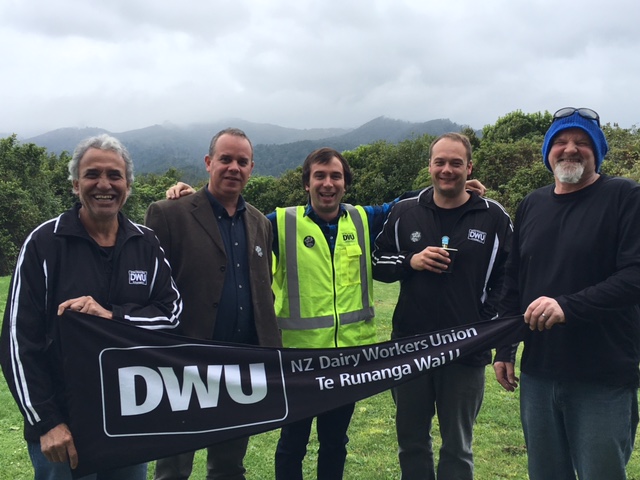
Dairy worker delegates and organisers with Cuban Ambassador.

The Mayday seminar on the way forward for the Coast economy was designed as a story-telling event, to test whether there is a narrative we can begin to inhabit. The seminar was union led, with the unions being joined on the organising committee by Runanga and Blackball community organisations and the Grey District Council Economic Development Unit. This in itself is a story, which questions whether the discussion is necessarily led by managers and political leaders.

The seminar began with union organisers and delegates reporting from their survey of what Coast workers want? It proved to be a coherent story. The well-organised and fully unionised primary teachers want to retain their collective agreement, don’t want to be individualised by performance pay (instead want a better career path), are fully aware of and will resist corporate attempts to colonise the public system via charter schools and corporate product, and are acting in solidarity with support staff to raise the wages and conditions of these valued colleagues.

The health workers are equally committed to their collective, but are suffering stress and overwork from the underfunding of the service, underfunding designed to drive those who can afford it, into the private sector.

In the government sector and in midwifery, equal pay remains a big issue, as does work life balance. Midwives, self employed yet funded by the state, have only had a 2.5% increase in twenty years.

Those outside the state sector want well paid, secure and meaningful jobs, with career paths available. Not an extravagant  request, but one threatened by the increasing trend to precarious shift work, symbolised at its worst by zero hour contracts.

A cultural worker, who because of the nature of the field, has always worked precariously, stated how a Universal Basic Income would assist people faced with precariousness, as well as pointing out the injustice of arts funding being directed to urban areas.

The story told was a coherent one, of a desire for meaningful and secure livelihoods based in the Coast region.

The politicians and executive officers working in economic development were then asked to respond, this constituting another story. Kevin Hague identified the problem: we focus purely on economics, rather than focusing on the needs of people and the environment – the latter focus should then generate the economic system. But otherwise the response was highly individuated:  visions, personal aims and hopes, institutional charters, with two specific proposals for Buller being mentioned: the wood waste to diesel proposition and the incinerator proposal. But there have been community campaigns in Sicily against their poor region becoming the dumping ground for rich regions’ waste. Will there be community discussion and assessment or is any corporate offer to be jumped at? We seemed to be in a story of fragmentation.

The Cuban ambassador then told the story of the extensive and thorough consultation process (which is ongoing) as that country began to restructure its economy – every strata of society, from unions to farmers to students to neighbourhoods responding to a set of proposed changes.

After lunch three young professionals told their stories of ‘living on the Coast’. Nick was brought up here then left to further his education but has since returned, Elena managed to educate herself while remaining on the Coast (at one stage that required enrolling in a Queensland University on-line course) and Te Whaea has come here to teach. Each of these wonderful young people told of their reasons for living here, the advantages and compromises and their commitment to the community. Lifestyle, access to the natural world are balanced against fewer consumer and cultural opportunities. Affordable housing is a big plus. They reported excellent colleagues and mentoring, but Te Whaea felt the lack of visibility of the Maori story and the lack of multi culturalism (Mayor Tony Kokshoorn stated that funds have become available to tell the tangatawhenua story). But the simple fact that these young people were here, enjoying life and are committed to community involvement was a very hopeful story.

Of course there had been an elephant in the room, the neo liberal master story: that the economy and the political system should facilitate large, usually multinational corporations, to exploit labour, society and the environment in order to return a profit to an increasingly small number of people. We had avoided this story but were reminded of it by Karen Davis as she told of the dairy industry expanding to Chile and China and developing unsustainable farms on the South Island East Coast during the price boom, leading to cows being turned into machines, an inevitable over supply and the inevitable bust (politely called market adjustment), but during which bankruptcies, suicides and community implosions occur. As well, dairy farmers pay very little tax. But we didn’t want (and shouldn’t want) to be sucked into this story.

Three local small business people then told their stories, all equally moving and entertaining: of the creation of the iconic Blackball businesses which had proved sustainable and involved risks, guile and passion, of the absolute integrity of the Garden Shop and its body of skilled workers; of the Putake Honey people, moving from the higher echelons of the corporate world to bee keeping in Marlborough and now the Coast (supported by DWC), because life wasn’t making sense in the flash Sydney apartment. They were stories of passion and commitment, and stories based here.

Finally, there were two possible stories introduced: one the co-operative model developed by the Australian union movement, where union networks provide a committed market for a collectively created product; the other the social enterprise model, where the community organisation grows into a business serving local needs. It is a model which is now at the centre of the economy in many of the marginal rural areas of Scotland.

In the reflection process, there was a feeling of hope, based on the stories of committed people choosing to live here and making that choice a viable one. Damien O’Connor made the point that a change of government is required. It does require political institutions supportive of both collectivism and individual aspiration within that collectivism.

And it was here that there appeared a different beast in the room, the notion that the political party, if you like the story of representation, must originate from within the stories being told, rather than telling a story outside these stories. And of course, the story of socialism developing social democracy was of this nature. As soon as it diverted it disastrously failed. The environmental movement is another such story. Once again, as soon as it diverts it begins to fail.

How this story can be told is another story, yet to be told. Perhaps we could begin with a West Coast charter. Here are some suggestions of what might be in it.

  • That the Coast recognises the special place of tangatawhenua in the history and culture of the region;
  • That the Coast upholds unionism and the value of collective agreements to ensure equity and collaborative management;
  • That the Coast upholds the principles of pay equity;
  • That the Coast values work-life balance and flexible working schedules which contribute to that balance, as well as career paths in all work sectors;
  • That the Coast upholds the public ownership of education and health services, requests adequate funding and that collegiality be preserved;
  • That the Coast, realising an inevitable seasonality in some sectors, the pressures involved in small business and the precariousness that results, is supportive of a Universal Basic Income;
  • That the Coast celebrates and supports sustainable small business loyal to the region and passionate about quality and service;
  • That the Coast celebrates young people committed to the region and to their life here;
  • That the Coast will seek ways and means for a range of online tertiary education to be available to its young people in a supportive environment;
  • That the Coast insists on a regional royalty payment for materials extracted here;
  • That the Coast encourages local processing and the adding of value to materials extracted here;
  • That the Coast recognises the uniqueness and value of its environment and insists on sustainable practices in all areas;
  • That the Coast welcomes investment and corporate ventures but will scrutinise ventures according to the above values;
  • That the Coast in order to rectify the rural/urban divide requests population based access to funding in cultural and research and development areas;
  • That the Coast requests its remoteness and special needs be recognised in the funding of the health and education sectors;
  • That the Coast welcomes refugees from war torn and oppressive regimes and will enter partnerships that enable their transition to our community.

Wouldn’t it be great if such a charter were to be discussed at all levels of Coast society?

Blog at WordPress.com.

Up ↑