Search

PO Box 2 Blackball

Paul Maunder's blog

Month

September 2022

The lengthy funeral of feudalism

The Queen’s complex and lengthy funeral reminds me of the long journey away from feudalism and the fact that we never quite put it to rest as a political and social system. It seems there is no mausoleum big enough.

Guardian.uk

It is of course nonsense that because someone is born into a particular family that they have characteristics which make them suitable for leading positions in society. At its zenith it was considered an act of God, hence the divine right of kings (and occasionally queens) to have autocratic power. Economically, for those on the next level (the lords etc), land ownership was involved because it brought with it indentured labour in the form of serfs and bonded peasants. Along with that ownership came civil and legal positions which often brought financial reward. Once again this was justified by birth and a natural right to leadership.

With the advent of capitalism and the merchant, manufacturing and service classes, entrepreneurialism and subsequent wealth in the form of capital rather than land, acquired in a lifetime and not being attached to birth, confused things. But often marriage into the aristocracy or buying a feudal estate from a bankrupt lord brought a pretence of birth right and the blessing of religion.

The nonsense of birth right has been whittled away, yet remains resilient, for capitalism produces little graciousness or formal pageantry. So royal families have persevered and continue to impress – celebrities don’t quite make the grade of princesses when it comes to ribbon cutting. And there are feudal values of service, obedience and faith which contrast with capitalist values of ambition, greed, individualism and consumerism.
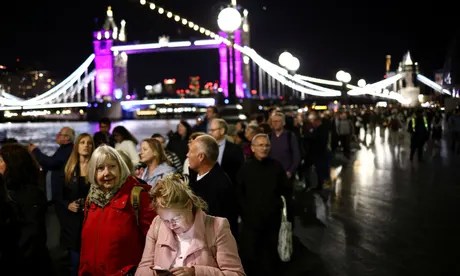
Join the queue. Guardian.uk

And of course, birth right is at the heart of indigenous cultures. But once an indigenous people become a nation, the concept of nation and nationality comes onto the agenda. For example, Samoan nationality exists both through birth, but also through citizenship via marriage or naturalisation after a period of residency, so that being a Samoan citizen is not totally dependent on birth.

Māori nationality doesn’t exist in the same way, for there is no Māori nation. If one is not born Māori you can’t be Māori. You can’t ‘become’ Māori through marriage or residency.  There would seem to be an issue here with the treaty, in that it is not a partnership between two sovereign nations, and to become a sovereign nation means giving up the primacy of whakapapa. So, what is the legality? A partnership between a sovereign nation and the iwi leaders who have feudal rights over areas of land. But then co-governance at a combined level over issues and resources which involve all citizens obviously does create some controversy, as we are finding.

Complex issues, able to be pondered on during an eight hour wait to file past the Queen’s coffin. Except prime ministers don’t have to wait, can jump the queue with the aid of a curtsy. Although the Saudi king is dodgy so maybe he won’t be allowed. But that’s another issue. What if the bloodline produces some dodgy characters unfit to rule? We’d need to go back to the beginning of the queue to have the time to ponder that one. And why not get rid of the whole concept of birth right? Pension off the royal family? They don’t even need a pension, they’ve got enough money and lots of castles – 700 rooms in Buckingham Palace, plenty of space for the homeless.

Will this never end might become the motto as we shuffle forward?

Wellbeing

As the aspirational concept filters through from Treasury and it becomes one of the required outcomes of more generally oriented programmes, ‘wellbeing’ has become a buzz word for government departments and their programmes. Suddenly one has to consider it, for departments holding the purse strings are considering it. What comes to mind if I free associate is firstly the Wordsworthian sentiment (which I can occasionally share on a spring morning) that, ‘God’s in his heaven and all’s well with the world’, followed by the memory of first falling in love, followed by the gentlemen’s club custom of a pre-dinner brandy and a good cigar, followed by the more modern chemical addiction of a joint with friends…if you google wellbeing images you find yoga poses and flowers.

But once the bureaucrats get hold of it, it is more complicated, with always the problem of measurability. The following list is from Statistics NZ. Under the heading, ‘Subjective wellbeing’, there is the ‘Ability to be yourself, Family well being, Hope for the future, Life satisfaction, Sense of control, Sense of purpose’. Each of these is pretty complex I would have thought. We move to, ‘Cities and settlements’ and under that heading we have, ‘Access to natural spaces, Commuting time to work; Homelessness; Housing affordability; Overcrowding; and Resilience of infrastructure’. That might seem a little simplistic as well. And then there is ‘Active stewardship of land’ – presumably that means having a garden. When it comes to ‘Health’ there is the startling concept of ‘Amenable mortality’, which proves to be premature deaths; ‘Health equity; Mental health status; Spiritual health, Suicide’. How do they measure a person’s spiritual health or the reasons for suicide? We move to ‘Economic standard of living’ and find: Child poverty, low income after housing costs; Child poverty, low income before housing costs; Child poverty material hardship; Income adequacy; Income inequality; Low income; material well being; Net worth; Value of unpaid work’. After digesting those, we move to ‘Social connections’: ‘Contact with family/whanau/friends; Loneliness; Social support’… The list then moves to ‘Work’, ‘Culture’, ‘Air quality’, ‘Identity’, ‘Leisure’, ‘Waste’…

We’re a long way away from that spring walk and I imagine it keeps government departments in Wellington and elsewhere very busy trying to report on the above. There’s probably some IT wizard designing the algorithm. Union membership doesn’t feature, and given that is a way toward achieving many of the above, including a sense of belonging and identity, it would seem a notable absence. There’s also the conundrum from the 1960s when children (white children mainly) brought up under a new time of relative affluence and full employment rebelled against the suburban wellbeing that was their lot. And a further conundrum: the connectivity and general vitality of the less well off in the developing world.  

A further irony: a friend works for Statistics gathering information for the above. It’s casual work on the minimum wage. To avoid the accusation of zero hour contracts, they’re guaranteed 17.5 hours work a week. I pondered that figure then realised it was set to just below the 20 hour a week which would allow a worker access to Working with Families. That’s pretty mean minded and blinkered I would have thought for a government that is concerned with wellbeing. Not to mention penalising those poor bastards who still need a smoke to cope with the anxieties of being at the bottom of the heap. Or the kids living in motels. Or the rest homes short of 12000 nurses…

Some time during the 1990s, bureaucrats were writing units of learning for NZQA and NCEA. I sat in on a few panels considering drama units and would suffer a headache from the mystification being imposed. Occasionally I would analyse a draft unit, word for word, sentence by sentence, pointing out that it was illogical, often tautologous and bore no relationship to the realities of acting or directing. I would be met with blank stares and that crinkling of the eyes when faced with the recalcitrant. They signed them off and then exemplars were produced. For the practitioner it was a matter of choice: either ignoring it all, getting on with the job and then making up some reporting at the end, or, as newcomers often did, being obedient and teaching nonsense.

As someone wrote in the Spinoff last weekend, this government is brilliant at being aspirational, and rather hopeless at achieving anything very much, with the notable exception of Fair Pay Agreements.

Blog at WordPress.com.

Up ↑