Search

PO Box 2 Blackball

Paul Maunder's blog

Author

taipoutiniblog

Playwright, writer and cultural activist living in Blackball on the West Coast of the South Island of New Zealand.

Politics as storytelling

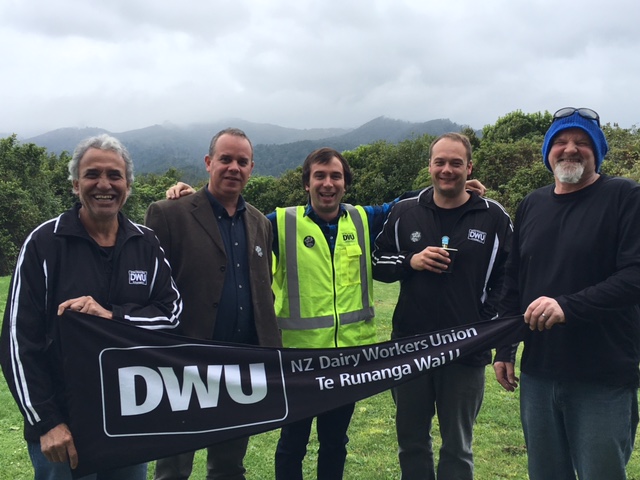
Mayday pic

Dairy worker delegates and organisers with Cuban Ambassador.

The Mayday seminar on the way forward for the Coast economy was designed as a story-telling event, to test whether there is a narrative we can begin to inhabit. The seminar was union led, with the unions being joined on the organising committee by Runanga and Blackball community organisations and the Grey District Council Economic Development Unit. This in itself is a story, which questions whether the discussion is necessarily led by managers and political leaders.

The seminar began with union organisers and delegates reporting from their survey of what Coast workers want? It proved to be a coherent story. The well-organised and fully unionised primary teachers want to retain their collective agreement, don’t want to be individualised by performance pay (instead want a better career path), are fully aware of and will resist corporate attempts to colonise the public system via charter schools and corporate product, and are acting in solidarity with support staff to raise the wages and conditions of these valued colleagues.

The health workers are equally committed to their collective, but are suffering stress and overwork from the underfunding of the service, underfunding designed to drive those who can afford it, into the private sector.

In the government sector and in midwifery, equal pay remains a big issue, as does work life balance. Midwives, self employed yet funded by the state, have only had a 2.5% increase in twenty years.

Those outside the state sector want well paid, secure and meaningful jobs, with career paths available. Not an extravagant  request, but one threatened by the increasing trend to precarious shift work, symbolised at its worst by zero hour contracts.

A cultural worker, who because of the nature of the field, has always worked precariously, stated how a Universal Basic Income would assist people faced with precariousness, as well as pointing out the injustice of arts funding being directed to urban areas.

The story told was a coherent one, of a desire for meaningful and secure livelihoods based in the Coast region.

The politicians and executive officers working in economic development were then asked to respond, this constituting another story. Kevin Hague identified the problem: we focus purely on economics, rather than focusing on the needs of people and the environment – the latter focus should then generate the economic system. But otherwise the response was highly individuated:  visions, personal aims and hopes, institutional charters, with two specific proposals for Buller being mentioned: the wood waste to diesel proposition and the incinerator proposal. But there have been community campaigns in Sicily against their poor region becoming the dumping ground for rich regions’ waste. Will there be community discussion and assessment or is any corporate offer to be jumped at? We seemed to be in a story of fragmentation.

The Cuban ambassador then told the story of the extensive and thorough consultation process (which is ongoing) as that country began to restructure its economy – every strata of society, from unions to farmers to students to neighbourhoods responding to a set of proposed changes.

After lunch three young professionals told their stories of ‘living on the Coast’. Nick was brought up here then left to further his education but has since returned, Elena managed to educate herself while remaining on the Coast (at one stage that required enrolling in a Queensland University on-line course) and Te Whaea has come here to teach. Each of these wonderful young people told of their reasons for living here, the advantages and compromises and their commitment to the community. Lifestyle, access to the natural world are balanced against fewer consumer and cultural opportunities. Affordable housing is a big plus. They reported excellent colleagues and mentoring, but Te Whaea felt the lack of visibility of the Maori story and the lack of multi culturalism (Mayor Tony Kokshoorn stated that funds have become available to tell the tangatawhenua story). But the simple fact that these young people were here, enjoying life and are committed to community involvement was a very hopeful story.

Of course there had been an elephant in the room, the neo liberal master story: that the economy and the political system should facilitate large, usually multinational corporations, to exploit labour, society and the environment in order to return a profit to an increasingly small number of people. We had avoided this story but were reminded of it by Karen Davis as she told of the dairy industry expanding to Chile and China and developing unsustainable farms on the South Island East Coast during the price boom, leading to cows being turned into machines, an inevitable over supply and the inevitable bust (politely called market adjustment), but during which bankruptcies, suicides and community implosions occur. As well, dairy farmers pay very little tax. But we didn’t want (and shouldn’t want) to be sucked into this story.

Three local small business people then told their stories, all equally moving and entertaining: of the creation of the iconic Blackball businesses which had proved sustainable and involved risks, guile and passion, of the absolute integrity of the Garden Shop and its body of skilled workers; of the Putake Honey people, moving from the higher echelons of the corporate world to bee keeping in Marlborough and now the Coast (supported by DWC), because life wasn’t making sense in the flash Sydney apartment. They were stories of passion and commitment, and stories based here.

Finally, there were two possible stories introduced: one the co-operative model developed by the Australian union movement, where union networks provide a committed market for a collectively created product; the other the social enterprise model, where the community organisation grows into a business serving local needs. It is a model which is now at the centre of the economy in many of the marginal rural areas of Scotland.

In the reflection process, there was a feeling of hope, based on the stories of committed people choosing to live here and making that choice a viable one. Damien O’Connor made the point that a change of government is required. It does require political institutions supportive of both collectivism and individual aspiration within that collectivism.

And it was here that there appeared a different beast in the room, the notion that the political party, if you like the story of representation, must originate from within the stories being told, rather than telling a story outside these stories. And of course, the story of socialism developing social democracy was of this nature. As soon as it diverted it disastrously failed. The environmental movement is another such story. Once again, as soon as it diverts it begins to fail.

How this story can be told is another story, yet to be told. Perhaps we could begin with a West Coast charter. Here are some suggestions of what might be in it.

  • That the Coast recognises the special place of tangatawhenua in the history and culture of the region;
  • That the Coast upholds unionism and the value of collective agreements to ensure equity and collaborative management;
  • That the Coast upholds the principles of pay equity;
  • That the Coast values work-life balance and flexible working schedules which contribute to that balance, as well as career paths in all work sectors;
  • That the Coast upholds the public ownership of education and health services, requests adequate funding and that collegiality be preserved;
  • That the Coast, realising an inevitable seasonality in some sectors, the pressures involved in small business and the precariousness that results, is supportive of a Universal Basic Income;
  • That the Coast celebrates and supports sustainable small business loyal to the region and passionate about quality and service;
  • That the Coast celebrates young people committed to the region and to their life here;
  • That the Coast will seek ways and means for a range of online tertiary education to be available to its young people in a supportive environment;
  • That the Coast insists on a regional royalty payment for materials extracted here;
  • That the Coast encourages local processing and the adding of value to materials extracted here;
  • That the Coast recognises the uniqueness and value of its environment and insists on sustainable practices in all areas;
  • That the Coast welcomes investment and corporate ventures but will scrutinise ventures according to the above values;
  • That the Coast in order to rectify the rural/urban divide requests population based access to funding in cultural and research and development areas;
  • That the Coast requests its remoteness and special needs be recognised in the funding of the health and education sectors;
  • That the Coast welcomes refugees from war torn and oppressive regimes and will enter partnerships that enable their transition to our community.

Wouldn’t it be great if such a charter were to be discussed at all levels of Coast society?

Health and Safety

I spent Anzac Day in Alexandra, trying to integrate a couple of images.

First image: wandering around Riccarton Mall killing time before an eye check, I happened across a shop selling feel-good stationery, stickers, diaries, note pads, envelopes and the like, all little-girl pinkish and headed with New Age mantra (Where you stumble there your treasure is); the sorts of phrases people sometimes have, for some peculiar reason, on the back of their toilet door. Of course, primary school teachers will have a stock of stickers to reward student efforts, but this shop was for adults. I dreaded being on the receiving end of this pinkness, for it denoted an infantilism and the fixed smile of the bible class.

Second image: the new health and safety legislation includes emotional stress and harm. Fair enough, overwork and bullying (both horizontal and vertical) is now covered. But it has problematic ramifications in the education area. Filling in the Risk Assessment Management (Rams) forms is already complicated enough (you can no longer spontaneously take your class on a stroll around the block on a pleasant day), but now emotional safety is part of it.

Learning is always accompanied by a level of anxiety. Should children always be emotionally comfortable? If so, school drama becomes impossible. How can you comfortably act Romeo and Juliet?  (Ironically, in the same week the legislation was introduced, Sweeney Todd actually slit the throats of a couple of students in a school production of The Threepenny Opera.) How can you comfortably study apartheid or the holocaust or species loss? I have read of ‘comfort rooms’ in US colleges where students, feeling challenged by course content, can go and sit with soft toys and watch DVDs of dolphins playing.

Obviously, emotional health and safety can be about maintaining a level of narcissism which, given the role of narcissism in fascist movements, is politically very unsafe.

Marx called religion the opiate of the people. Taking opium transports one into a world without problems or stress. Paradise is a similar space, be it Christian or Muslim or Hawaiiki. For people living in oppressive circumstances with its stress and physical discomforts (including hunger) and without health and safety, the prospect of a comfortable eternity is an opiate, taking their mind off the reasons behind their personal discomfort.  It also enabled the system to use them as cannon fodder for war. I am sure WW1 was only possible because of a widespread belief that the dead went to heaven.

Freud on the other hand, talked of the oceanic feeling – the affective world of the baby at the breast – warm, soft and receiving the milk of life – making for a wonderful state of narcissism. Religion is based on a yearning for this oceanic feeling; so happy clapping, hymn singing, visions, and of course new ageism (meditation, massage…), and at a more banal level, feel-good stickers and the shop in Riccarton Mall. There is of course, the value and good works side of religious practice and the virtues of meditation, yoga, massage etc., and the hard work attached. I must also mention the oceanic feeling that can occur during performance or on the demonstration.

Emotional health and safety is then a complex issue, not easily dealt with by bureaucracy or the court system, or encompassed by a book of stickers for adults.

I take a stroll to the town centre and observe the solemn service to honour those who sacrificed themselves for ‘freedom, God, King and country’, in a series of wars where health and safety was not high on the agenda. I listen to a speech by a young woman who talks of their sacrifice so she could have choices in her life. Lucky her. I try not to think about the TINA (there is no alternative) mantra of neo-liberalism and the Panama Papers leak, child and sex slavery, the damage being done by Monsanto and agri business, the rich-poor divide, global warming…

But I have had enough of contradiction for one day, will go and take a two year old (thoroughly immersed in the motor narcissism of his age group) for a walk, and make sure he comes to no significant harm.

Southern man meets South Auckland boy

Taika Waititi’s film, Hunt for the Wilderpeople, is destined to be a classic, for two cultural traditions satisfyingly meet. The tiriti is at play.

For many Pakeha New Zealand males, the bush has been the place where you can escape, a place of refuge from women, the state, the law, whatever’s bugging you and tearing you up. The tradition is long: from Man Alone, through Dennis Glover, Fairburn, Baxter, and of course, in more populist form, Barry Crump. In this patriarchal dream world, women are difficult, and there is a variation of the Madonna/whore dichotomy. Instead, there is the ‘good sort’ woman who cooks and doesn’t judge, and can also stick a pig, gut a deer and tan a hide, opposed by the controlling and emasculating city woman, government servant, fussy mother, nagging-suburban-wife type.

Waititi takes a Maori slant on this and the result is very satisfying. A Maori kid in trouble, but with all the street wisdom and bro’ culture of South Auckland, is taken into the sticks, South of Jackson’s Bay or somewhere up the East Coast – it doesn’t matter – by an emasculating, Hekia-Parata sort of Welfare Officer, to be fostered by a Maori woman who is a good sort par excellence. Her bloke is more alienated and tethered, and not so keen on this nuclear family arrangement. But things work out for this fat, city kid.

However, the good sort dies. Hekia wants the kid back and the two lads head for the bush for a series of adventures, plus a bit of spiritual learning. On the way, they meet a third female type (one favoured by novelist, Noel Hilliard): the tough-angel, Maori girl. Anyway, the state gets them in the end, but the two boys end up back south of Jackson’s Bay with the tough angel and her dad and will undoubtedly live happily ever after.

In a society where the emasculating system regularly takes the form of the politician, bureaucrat, public relations, human resources, or marketing woman, this becomes a shout from the old male and the two protagonists are spot on. Julian Dennison’s face is memorable and this is a return to roots for Sam Neill. The whole is couched as a kids’ story with a touch of Victoriana.

It is also, of course, infused with a Maori/Polynesian cultural tradition: that of trickster or comedian. The traveller would turn up at the marae with some tall tales, and there are the village clowns in any PI village taking the mickey out of the village leaders – and this film is full of topical jibes. If we once again switch cultures, we have the commedia dell’arte theatre strand, here played out in Polynesian terms.

Maori also have their going bush tradition, but of greater seriousness. If conquered an iwi would go into the bush to rebuild the numbers and eventually extract revenge. There were Te Kooti and Titokowaru, guerrilla fighters for whom the bush provided cover (partly responsible for the Pakeha desire to cut it all down). In more recent times, going back to the rural area is not to escape the culture but to return to it. It is then, a more complex and more serious matter. It is right that Waititi has chosen the Pakeha paradigm and colonised it.

Of course, it remains male nonsense. The fat kid never loses weight, despite five months of scavenging in the bush for tucker, the farm doesn’t seem to have any animals, heat detection cameras make hiding out pretty difficult nowadays, that car wreckers is absurdly extensive for somewhere south of Jackson’s Bay – but it doesn’t matter – the impulse, the cultural dialogue and the wit is great. The male spirit has asserted itself in a wholesome and charming sort of way – a rare thing of late – and obviously very popular.

Rowley Habib (Tuwharetoa)

Rowley (later Rore Hapipi) has passed. A generation is passing. Rowley, Lebanese father, Maori Mum, was the first writer for the current Maori theatre movement. His dad was a shopkeeper in a small village near Taupo, part of the early Lebanese diaspora (the Lebanese have been called the Jews of the Arab world), but both parents died when Rowley was a child. He went to Te Aute College on a scholarship, then to teachers college, but had started to write so dropped out of the teaching game. He married and had kids and worked at all sorts of jobs, before ending up in Wellington. He was mates with Don Selwyn and observed the success and demise of the Maori Theatre Trust, a Pakeha-led venture seduced by patronage and spectacle.

With the 1975 Land March occurring and much talk of Tino Rangatiratanga, Rowley saw that there wasn’t a Maori theatre voice. He waited in vain for someone in the theatre world to do something and then decided he had to fill the gap. Jim Moriarty, Brian Potiki, Tungia Baker and Keri Kaa among others were around and Rowley got them together. He decided they had to start small.

He’d come across the transcript of a Maori Land Court case and was struck by the contrast between the Pakeha judge’s legal talk and the Maori family’s story of the land. The group, calling itself Te Ika a Maui Players, began devising a play based on the transcript. Eventually Rowley wrote it down and called it, Death of the Land.

Jim was also in the theatre group, Amamus, which I directed and when we put on Oedipus (a play about Pakeha guilt), we invited Te Ika a Maui to join us in a double bill at Unity Theatre. Bruce Mason wrote a favourable review and offers began to come in. Death of the Land played at marae, churches, universities, the Maori Writers and Artists’ Hui, even in Paul Reeve’s living room. It was community theatre, with a strong message.

The actor who played the Pakeha judge couldn’t make it for a performance at Waikato University, so I was roped in. It was a stereotypical part and it was uncomfortable playing the villain of the piece. We set off for Hamilton in a van and somewhere near Taihape picked up a young Pakeha hitchhiker- a broken sort of person with mental health issues. He was accepted without question by the group and invited to stay with us in Hamilton where we slept marae style in a lecturer’s lounge. That weekend, I witnessed whanaunatanga in action.

Amamus had been doing a series of plays exploring Pakeha identity, discovering along the way the fascist core of colonisation, so this experience stayed with me on all sorts of levels: political, cultural, personal, emotional… Later, in a Samoan village, I would have to confront the essential alienation of individualism.

Death of the Land was recorded for radio and Rowley wrote a couple of TV plays before he returned to prose writing and was awarded the Menton. But through his vision a Maori theatre movement had been launched . As he said to me in an interview a few years ago, ‘I’ve never thought big, I think small – and I was right.’

Ahakore he iti he pounamu (although it is small it is greenstone).

Rowley, thank you for what you were and for your gift to our culture.

The scandal of lotto funding

The hub of the wheel of capitalist ideology is the rags to riches story: everyone can make it up the ladder with hard work and grit. The top of the ladder becomes, like heaven, problematic – where does everyone fit? – but it remains a key story and at its most banal involves buying the lotto ticket. There is nothing sadder than the queue at the supermarket lotto counter.

But that banality and grief turns to outrage when one realises that lotto funds the community, heritage, environment and arts sectors. When it comes to the community sector, the working class, via the rags to riches dream, funds programmes that are often necessary because of low wages and benefit levels and the dissolution that poverty causes.

When it comes to the arts sector the anger persists. The lotto buyers, who probably have never seen the inside of an opera house, fund Creative New Zealand, which gives out money which subsidises the lifestyle of the urban middle class who attend arts events, visit art galleries etc. As English writer, Justin Lewis, succinctly commented, ‘Public funding of the arts represents the redistribution of wealth from the working class to subsidise middle class entertainment and middle class aesthetics.’

When I wrote my thesis I did some number crunching and came up with the shocking supposition that in 1994 ballet attendance was subsidised by $47 a seat, mainstream theatre by $33 a seat and opera $18  a seat. I doubt that this has significantly changed. This scandal is based on the belief that the art object is something unique created by experts who need to be subsidised by the state and attempts then made to distribute that unique object as widely as possible (once again subsidised by the state). Prior to 1994, lip service was paid to the other ideological position, that the making of the art object is an activity that should be carried out as widely as possible (with expert assistance when required) and subsidised by the state on this broad and democratic basis.

Prior to 1994, lip service was paid to the latter position. There were community arts councils and regional arts council with this agenda. But with neo-liberal restructuring these were abolished and instead, community funding programmes set up and administered by local bodies, each with an annual fund based on 57 cents per head of population, and with none of this money to be spent on salaries or administration. This has resulted in 14% of Creative NZ’s money going to the community, 86% going to the middle class. Not quite 1%:99%, but getting close. And of course there’s lots of postmodern diversity spin to cover up the inequality.

The Greymouth/Mawhera based  theatre group Kiwi/Possum Productions works as a community-based theatre group, exploring local issues and establishing in this way strong relationships within the community, and wider – we now have a following in Hokitika, Westport and Motueka. We have been grateful for Creative Communities funding – usually about $800 per project.  This year we wanted to involve more people in a show exploring a sustainable economy. I also thought it would be good to give a koha to some of our people for the work involved, so we applied to Creative NZ for five grand. We were turned down, but the Dunedin Fringe Festival got eight grand for their opening party! There has also been a CNZ review of theatre where submissions often focused on trying to expand the theatre audience, and they are holding a Big Conversation in June to explore arts relationships with audiences. Our experience on the Coast is of no interest to them.

I therefore weep crocodile tears when I hear that lotto ticket sales have gone down significantly and that Creative NZ is going to have to pull in its belt. One day the working class might wake up to the fact that the rags to riches story is bullshit and instead make a revolution based on equality, and on the fact that all people are creative.

Environmentalism

I went to a talk by Green MP, Steffan Browning, in Greymouth last week. A dozen or so people turned out, all good, passionate people. Seven thousand stayed away, including local councillors and council staff.

The talk was about the effect of neonicotinoids, the neuro toxin in modern insecticides which is particularly damaging to bees. Neo-nics, as they are popularly called, attack the nervous system of insects, killing them. At sub lethal levels, they impair the navigation and learning system of bees, plus reduce their immune system and their fecundity. As the poison is systemic, it travels through the plants into the soil and hangs around for a long time. Given the vital role of bees in pollination and agriculture, it seems pretty dumb to poison them, yet these insecticides are not banned, or even studied by the Environmental Protection Authority.

And then there is the weed killer, glyphosate, the active ingredient in Round Up, and used widely by Councils to control weeds in playgrounds, parks and streets. The scientific evidence is pretty conclusive that it damages genes and is therefore carcinogenic, it affects hormones and the endocrine system, can result in kidney and liver damage and reduces the effectiveness of antibiotics. It’s not good news for bees either. Banned? No such luck. Being looked at by the EPA? No. What do we do? Sign a petition, lobby the council, etc. etc. Not too hard.

The next day I was ready to forget, put it into the unconscious as it were, but as I am beginning to research a book on environmentalism and the Coast, I need to comprehend the politics, or is it, the consciousness of it all? Why aren’t we massively angry at climate change, the general poisoning of the environment, the madness of chemical companies, of multinational seed control, of species loss? Where were the other seven thousand people?

Reading so far, reveals three branches of environmentalism. There is the wilderness cult which has resulted in national parks and species protection. There is the sustainable economy and society school, which necessarily recognises that the planet has limits. Finally, there is the environmental justice movement, which focuses on the environmental oppression of indigenous people and the poor. The former tend to be led by the middle class and the comfortably off, the latter tends to be the site of anger and direct action and one could include action over oppressed animals and birds (battery hens and pigs) – although the wilderness cult has produced some tree sitting and Greenpeace direct actions.

It becomes a matter of consciousness, how to turn that dozen people into seven thousand people lobbying council, how to create a daily consciousness, so that the sight of a bee makes one think of neo-nics, to change our attitude to weeds and tidy public spaces, to be horrified at how many times the spuds we buy in the supermarket have been sprayed… then the economics of it all, and how do people, everywhere, earn a living? And it is, with globalisation, such a universal issue, so tied to global capital and investment and free trade deals and underfunded (deliberately) government agencies.

A particular area of land is the site of belonging for an indigenous people, is their identity, so they are willing to tackle the grey mob of capitalists and their political stooges. Perhaps deep ecology, that tuning into the natural world, is the closest we colonials can get to that. Certain exercises by my theatre guru, Grotowski, can put me into that space. But we still have to go to work and be compliant.

I have to acknowledge the achievements of the environmentalists over the last decades. It is a matter though of changing the world, of a revolution of consciousness and political system. And to realise that the planet doesn’t care if we totally stuff up and return it to the bacteria for some millions of years. The planet doesn’t have a consciousness. We do. The necessary revolution is for the sustaining of human society and must embody a profound empathy for the planet we have inherited.

Meanwhile, I will write a letter to the council.

Goats and the media

There’s been a family of goats hanging around the village for a few months now, coming down to browse some empty sections. Not an issue – dogs, chooks and pensioners roam as well. Until someone rang the Council and the animal control officer threatened to cull them (the goats not the pensioners).

For some reason the goat story took off (lack of news on a Sunday?) and escalated (‘small town besieged by wild goats’ sort of thing), even hitting the BBC. Someone started a petition to save the goats and the persecutor/victim/rescuer pattern was complete.  And then, inevitably, a tv crew arrived. A strange thing, a tv crew. They have the promise and threat of a band of guerillas passing through town. Except they don’t bring a manifesto, simply the promise of exposure. The goats, very sensibly, failed to appear, refusing to have their fifteen minutes of fame.

After a week, it seems to have settled down, but the episode has led me to ponder on how much of the news from afar is similarly fabricated, created in fact out of not very much. Whereas the real news is ignored, other than locally.

There have been two very good articles recently in the local paper, both by local health professionals. One was written by a doctor highly critical of the lack of good faith on the Government side in the hospital rebuild process, revealed by the absurd spending of $700,000 on consultant fees to save a supposed overrun of $1.6 million, an overrun easily covered by contingency. The other, necessarily anonymous article, was by the A&E staff, pointing out that the A&E Department reaches only 16% fitness on the current earthquake scale, and that when the new Health and Safety Regulations kick in, the charge nurse becomes liable, if the building collapsed, to a $600,000 fine for operating a business in an unsafe environment.  Not only that, but quite possibly, patients’ health or life insurance could be void for choosing to be treated in the building. Given such circumstances, a rebuild would seem to be a top priority. To cap it all, the same Department which is being very dilatory spends $19 million dollar on an overrun in the refit of its head office. This scandal would seem to be worthy of the national news, even the international news, rather than a family of goats munching in some empty sections.

But that’s the nature of the news, and it is an addiction. Even though we know it’s bad for us, we continue to consume.

Blast from the past

It’s been Vietnam War week on Maori Television, first of all, a documentary on the saga of making Apocalypse Now and then the showing of the two major Vietnam War films: The Deer Hunter and Apocalypse Now; the latter a remarkable movie – 20th century Shakespeare – and the former interesting in its portrayal of working class life in what has now become the ‘rust belt’, and also containing one of the great wedding scenes.

Both movies explore key Vietnam War themes: the underlying violence of American culture, the naivety and drug-fueled hysteria of the mainly Afro-American and poor white conscripts when faced with the single-minded belief in their cause of the Vietnamese enemy; the opulence and uselessness of the technology in the hands of the Americans (they dropped more bombs on North Vietnam than on Europe in WWll); and the alien, jungle landscape.

Rich themes. But watching the movies again fifty years later, I was struck by the filmmakers’ unwillingness or inability to portray the Vietnamese cause in any shape or form, to look at what the Communist regime was offering, to examine Vietnamese history and motivation – and, perhaps this is the central characteristic of imperial cultures, their essential narcissism. The Vietnamese are portrayed as either a hidden away and invisible threat or, if they do appear, as cruel and sub human ciphers. There is little excuse for this, for there had been visits to North Vietnam by a variety of intellectuals and writers, e.g. Sartre, Peter Weiss and Mary McCarthy, who had subsequently written articulately about these matters.

It was a war that was impacted upon by both the counter-culture and television. For the first time, the cruelty of war was immediately shown in the nation’s living rooms, and there were some famous images: the naked, napalmed child running down the road, the hippy girl placing a flower in the barrel of a soldier’s gun… The demonstrations were huge. I went to one in London where two million people marched – it took all afternoon for that number of people to walk along the route. Uncle Ho became a revered figure, the Cubans had made a revolution and Che roamed the globe. I remember reading of the human body being the model for the Vietnamese Army: the official army being the backbone, the regional units being the arms and legs,  while the village squads were the fingers and toes.  It was a war where the Vietnamese pitted bicycles against B52 bombers and won – the empire was defeated. Heady times.

But the narcissism was only momentarily fractured – like a drunken teenager going too far and smashing the family car. Lessons were learned: restrict and embed the press, be wary of committing ground troops, keep students in debt via student loans and keep them busy via marking schedules, and the mainstream culture, even when critical, helped heal the narcissism. And of course, as Eastern European regimes collapsed,  the domino theory started to work in reverse. Without the ideal of Communism, there is no alternative.

Empires, instead, collapse slowly, as those they have colonised invade the homeland and its institutions, colonising in turn. The Roman Army was suddenly made up of those they were supposedly controlling. The subversion is often devious and unpredictable; witness the influence on the Republican Party of the conservative Cuban exiles – making the party toxic. The South Americans supply the drugs; the Hispanic population becomes volatile; the Afro-Americans are still to have their revenge. As with the Roman Empire, this collapse is incoherent, flamboyant, and often cruel, with some glimmers of hope.

Caught by Madness

Writings a funny business: the impulse can come from real life – something has happened which you use; or sometimes you write something then it occurs in real life – as if you’ve made it happen. The latter is always unsettling.
Last year I wrote a play, A Brief History of Madness, loosely based on Foucault’s Madness and Civilisation, in which he looks at the different ways that societies have coped with the mad. From being accepted on the margins of society and having something to say about the mainstream, they have, since the industrial revolution, become ignored (apart from the psycho-analysts) and ‘fixed up’ via medications and therapies, re-engineered if you like. The theme obviously struck a chord, for it is has been our most popular piece.
The first half is set in a fictional Seaview Asylum, one of the large asylums that existed until recently. We thought it would be resonant (ghosts maybe?) to hold our Hokitika performance in the hall which remains on the site – most of the villas are rotting away, other than one which has been converted into a backpackers. Bookings had been tardy, so I prepared a billboard for the main road entrance, set it up upon arrival and waited for the woman with the key to arrive. When she did so, she had the billboard in her car. I’m not having that down there, she told me. Puzzlement. Why not? That word. I don’t approve. What word? Madness. But that’s the title of the play. I don’t like it. But-! I’m not having it. Come with me. We entered the backpackers. Let’s think of another word – I’m sensitive to that word. This was outlandish. The billboard was on a public road, we were hiring the hall, and this woman was trying to censor the title, which had appeared in advertisements and press releases. She looked at me earnestly. I think it’s wrong to call someone mad. But that’s what we’re saying in the play – sort of. Let’s think of another word, then you can write the sign out again. Time was ticking by. We needed to start setting up. Look, my mother died in Porirua mental hospital. I’m sensitive as well. I know. How do you know? I worked there. This was entering the realm of the fantastic. She didn’t even know my name, let alone my mother’s. Now, let’s think of another word. I was getting angry by now, but she still hadn’t handed over the key. I could envisage a situation where she refused to do so. Was she mad? It seemed mad. What does that mean? I breathed deeply. Down the road stood the statue of Te Whiti and Tohu. Some of the ploughman had been brought up here to be incarcerated. Be patient. Look, don’t worry about it. But she remained determined. I’m sure there’s another word, if we just sat down and thought about it. The cast were arriving. I’m very sorry, but I haven’t time for this. I really need the key. We have to get to work. She reluctantly handed it over. I took the billboard and left.
It turned out fine. There was a large, receptive audience. Someone brought a four year old along. Afterward she came up to me. I really liked your play. I liked the way everyone acted silly. Perhaps that was the word we were looking for: A Brief History of Silliness.


When I took the key back, the woman was softer, eyes limpid, wanting to make contact. Did it go alright? Very good, thanks. Something in her had been resolved. She’d rejected madness.
We parted on amicable terms.

Blog at WordPress.com.

Up ↑