Search

PO Box 2 Blackball

Paul Maunder's blog

Alarum Bells

I seem to remember some years back, ACT leader, David Seymour Dancing with the Stars, which was not a pretty sight. Now he seems to be venturing into the stand up comic business, in which he has greater ability. The routine is that of a pompous little prat who can’t organise a school lunch programme trying to change our constitution and transform the regulatory routine against all advice. From a perfectly sensible framework of local food for local kids made by local providers he is now having to bring in packed lunches from Aussie. Perhaps he’d like to import a tiriti relationship as well?  Mmmm.The sight of our David as Deputy Primie Minister is sure to have the audience in stitches.

More generally ACT ministers are proving a disaster, from a Minister for Children with a personal grudge dismembering social service provision, to a Minister of Workplace relations who won’t meet with the unions, to a culturally illiterate Minister of the Arts – this from a party which preached good management. 

Like all neo-liberals (I think we have to call them neo neo-liberals by now) they are brain dead zombies chanting slogans, Unfortunately they seem to have led National into the same abyss of idiocy.

And then catching by accident, Winston Peters’ address to the nation, I was reminded of the words of the 20th century philosopher and analyst of fascism, Hannah Arendt: The ideal subject of totalitarian rule is not the convinced Nazi or the convinced Communist, but people for whom the distinction between fact and fiction and the distinction between true and false no longer exist.

The Palestinian Solidarity movement, very concerned and ashamed by Foreign Minister, Peters’refusal to make a stand against the genocide in Gaza, were protesting outside the venue where theNZ First faithful had come to listen to their leader’s State of the Nation address. Winston has of course recently been to Washington and met with some of the Trump cabal and being the opportunist that he has always been, has immediately picked up on their jargon. The people outside were ‘ignorant, left wing fascists’, ‘long haired bludgers who have never done a day’s work’, ‘Communists’, ‘anti democratic’, ‘woke’, ‘Marxist whingers, encouraged by the media’.

They don’t know what they’re talking about. He’s had meetings with the Palestinian Authority, Egypt, Indonesia and the President of Turkey and he knows the reality of geopolitics (the Palestinian Authority are collaborators with Israel, Egypt is held over a barrel economically by the US, the President of Turkey is a dictator and Indonesia is a fragile democracy, committing significant human rights abuses in West Papua and cracking down on religious minorities, women, and sexually diverse people). Not a great bunch to take your cue from.

As Winston had trouble with his articulation – he is getting on – there were echoes of Trump. When some protests erupted from the hall, he led cries of ‘shame’, and ‘get them out’. In terms of foreign policy, he has decided there are big changes happening and we should keep our own counsel, not speak out, prepare for what is happening strategically and seize the opportunities to sell our country. Ethically then, he is a barrow boy.

Later in the speech, other than the traditional NZ First’s appeal to the provinces and the need forresource extraction, development and local democracy versus Wellington bureaucrats, he was big on getting rid of diversity, equity and inclusion policies, anti-trans, anti sex education, and in an appeal to the anti-vax people, anti fluoridation, Environmentally, we make no difference anyway, so why be idealistic and wear a hair shirt.

The Labour Party and the unions are both full of university-educated woke people who have never been workers so don’t know what it’s like and have betrayed their roots. Richard Seddon was the man and we need to return to our settler realities and be one people (he forgot to say that a greatdeal of Maori land was alienated under Seddon). He didn’t say the phrase, but it will come, Make New Zealand Great Again, which would be a more emphatic way of saying, NZ First.

The problem is that Winston Peters fits Hannah Arendt’s definition of the ideal subject of totalitarianrule, perfectly. As do his followers. There is no differentiation between fact and fiction, or truth and falsehood.

So, in this coalition, we have one partner who brings the chaos of neo liberal economics and the desire to capture the state for the purposes of the rich, the other who is appealing to populism in its current form, a form which , led by Trump, is very ugly indeed. Both tendencies are essentially undemocratic and potentially totalitarian. Winston is too lazy to be evil, David is too stupid to be a big-time influencer, but together, and with a confused centre-right partner they could nudge NZ down a path of half-arsed fascism.

The election can’t come soon enough.

New Year thoughts

It’s a confusing time politically. Outrage has proved useless as the millions walking the streets in protest against the genocide in Gaza and the West Bank are ignored. Freedom of speech is curtailed in Western democracies. Surveillance increases. The shift towards a proto fascism gains traction. Feudal rentier billionaires gain authority and control.  The digital world becomes ever more invasive and controlling and AI seriously begins to colonise communication. A new wave of imperialism surges and the Left is disordered ideologically and practically as the New Year brings a cascade of donation requests. A free Palestine becomes a romance as the genocide continues to be funded and abetted. A further slow genocide takes place for Cuba. Air power including drones which simply destroys infrastructure becomes the modus operandi of political thuggery. The climate crisis reaches a tipping point. In the States the economic basis of political advocacy organisations is threatened by a change to tax law. The small beacon of hope, Rojava, where a socialist, anarcho syndicalist state structure based on the liberation of all identities, is seriously threated by Turkey and Iran. Despite a lurch to the right and a return to the neo liberal model we are so far, sufficiently distanced, to potter along half decently but will be drawn into the mess in our usual self-effacing way. The assassination of a health insurance CEO resonated widely as a moment of justice, sending a whole caste scurrying for security and protection.

Are we in fact in a situation somewhat similar to pre revolutionary Russia, where the occasional act of domestic terrorism revealed the realities of the terror of the system, even while it intensified that reality? What must we insist on? For a beginning, innocence is not an option. Organisations that depend on charity are overly vulnerable. Truth telling is necessary and the hard dialogues must be held. What are we aiming for? What world is possible? What has to be given up? What about ‘the workers’? What is ‘the people’? What collaborations are rejected? Do we need to stop being polite? How do we protect our organisations? Where is the rhythm? What is the antithesis? Is there a counter hegemony? And of course, What is to be done?

Crisis

As Trump assembles a team of fascists and we know a new McCarthyism will take place, the Left are left gob-smacked by the realisation of the depth of the rout, mutterings of equity and justice from the academy increaingly marginalised, shivering from the realisation of who voted for him – even Afro American, Latino, Middle Eastern people, women… Our beliefs can become platitudes and a testing time lies ahead. Are we capable of resisting the terror? Do we have the structures?

It will be horrific for Palestinians as the genocide and Nakbar proceeds. Cuba is also in the firing line bigtime. As is Iran. Expressions of moral outrage will no longer be enough. Is there a generation of disenchanted youth who will eat the beast from within? In some ways the soccer riots in Europea against Israeli fans bring hope. When the violence penetrates to the centre, the establishment may lilsten. They will shout and condemn but when property is threatened, they sometimes listen, despite themesleves.

And what of the UN? Salvageable? And the climate crisis? And BRICS as an alternative global order? Difficult times requiring political organisation of a resolute kind. Webinars and left wing branding will not bring down the Empire. Nor long-winded legal machinations. Nor performative gesturing adding to the spectacle.

This is a fight for life.

The World

With the absolute clarity of the current period of genocide in Northern Gaza, the absolute clarity of Israeli intent on cleansing the West Bank and Gaza of Palestinians whether by death or expulsion and the world’s refusal to intervene, any pretence of there being a moral global order disappears. We are left with the fact that we have reached a new stage in the decline of the Western colonial project and need to acknowledge that nation-state gangs have taken over. This must be accompanied by a further realisation that warring gangs are unlikely to solve any of the pressing issues and that we are left with opportunism and narcissism and that the spectacle which bemuses will become increasing manipulative and psychotic.

But what do we do? – as a residential cruise ship for millionaires named The World (but without any refugees on board) enters Wellington Harbour?

The World, tied up at Pipitea Wharf

The exotic trees of Kōtuku

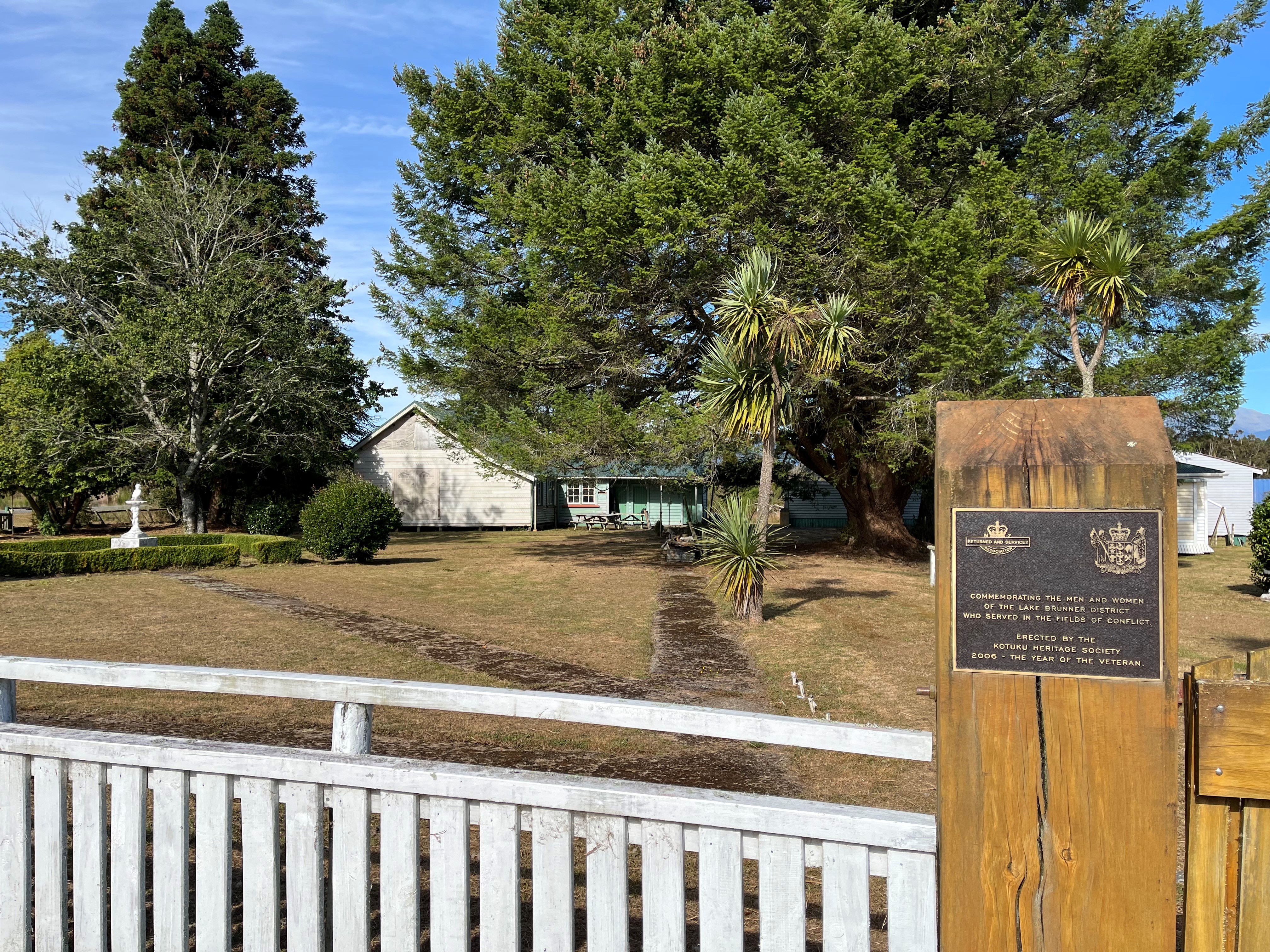
Having finished well enough the repair and upgrade of the old Jack’s Mill School near Moana and now beginning the operation of a School for Social Change in Te Wai Pounamu on the site, we have a remaining substantial problem: what to do with three large exotic trees that were planted some time ago, quite possibly as acts of commemoration, trees which have not been managed and which now shade the buildings. In the event of a hurricane type event they might fall and destroy the heritage infrastructure and meanwhile they discard large amounts of tree litter that block guttering, rubbish the lawn and occasionally branches fall which would be dangerous to anyone walking underneath.

As we struggle with this problem, the trees, for me, begin to be symbolic. They are exotic plantation trees planted individually in a domestic setting so it was a dumb thing to do (that is lacking in foresight). In their native setting the discipline of the collective plantation would have kept them from overspreading and protected them in a wind event. In the temperate and wet West Coast climate they have grown quickly and hugely.

Given that this is a heritage site and because momentarily, on a sunny day, they can be attractive and impressive, some think they are part of the heritage and should therefore be retained.

DOC who own the site but who have devolved the management to the community, dither, have no money for maintenance, but intermittently pay for a conversation report in order to cover their arses.

The community doesn’t have any money for the task and cutting down trees is not sexy for funders.

I have consulted local tree fellers but generally they cut down trees in paddocks for firewood and after expressing confidence in their ability to deal with these trees in a straightforward manner, they have second thoughts and wander away. As well, they generally don’t have the range of insurance cover necessary. A Christchurch arborist who could dismantle the trees in the city manner, needs $30,000 to do so.

To provide amusement DOC reports that there’s a person, presumably hunting around for a thesis topic or a consultant touting for work, who wants to apply for funding to write a heritage landscape report on the site, which, if completed would mystify the situation further and generally piss off the community, for she would be getting paid and the community involved are volunteers. And where does she come from and who is she? We’ve got a core group running the workshop programme, we’ve got the local school involved in resurrecting the landscape and the community, more generally, are having a dialogue with these lefties who now run the site and who have done a good job so far and apart from their dodgy politics, seem okay as people. The local hapu are beginning to use the place as well and now toot on their way home and recently invited me to attend a wananga on traditional embalming during which I offered my ageing body as a stand in corpse. And finally, both sides of the Gloriavale saga have popped in. So, what’s with this consultant?

It’s not hard to see this whole situation as a parable for the wider world where the problem of coloniarity (a word which embodies both the act of colonisation, past and present, but also the mindset that goes with it and the wider resonances) – is here symbolised by the overbearing trees.

7 out of 50,000

Visiting Invercargill we joined the local Palestinian Support Network as they protested in the local supermarkets against the selling of Israel sourced products, in particular Obela hummus. They were good people and it was a privilege to join them. But when we went home to family only the eleven year old was interested. You what? You went into a supermarket and took stuff off the shelves without permission? They didn’t try and stop you? He took some convincing. Palestinian protestors become in fact a different species. So that the  puzzle of the other 49993 local people who are witnessing a live-streamed genocide without protest becomes slightly less puzzling – and I’m not being critical of Invercargill here – it is the same everywhere. For some, protest is foreign, as is the issue. Some are scared off by visa requirements. There’s the danger of getting known in a smallish city. Some will have registered the ineffectiveness of the moral outrage protest. After all 100 million people protesting the Iraq invasion had no effect. How many have protested this genocide with no response from the Empire?

As the international protest turns more to the boycott, it does take it into the tetchier and more serious territory of economic interests. Quite simply, if Israel was denied weapons and fuel, the war would stop.. The Israeli economy could be crippled by an economic embargo such as is placed on Cuba, and its identity undermined by education, cultural and sporting boycotts.  If weapons were no longer manufactured because workers, supported by unions, were no longer willing to make them, wars would stop. But it’s not seriously happening. And if it started to, there would be a crunch point which would be very volatile indeed.

It all becomes self interested in a way. The group were pleased with their action and they should be. There is always the energy that results from performance, plus the video on facebook, the comments of passers by, the moral reward from having participated. We exist. It is no different from any performance. So, the performances compete for position in the performance cacophony which is the modern political scene.

So, change is incremental. I do wonder whether the constant simple non-judgemental questioning of the uncommitted would be useful? Do you know what’s happening?  How do you feel about it? Why aren’t you with us? A bit of a door knocking campaign, a collation of the answers into a theatre piece. Trying to puzzle the complex web behind it all.

Demolition Derby

The providers of social services to children and whanau who contract to Oranga Tamariki but sometimes other state institutions like health and education, are currently under attack by the coalition government who seem dictated to by ACT and NZ First to a surprising degree. As Gordon Campbell has pointed out the minor parties, cobbling together something like 12% of the vote are running the policy show. It is far worse than First Past The Post.

The neo liberal and managerial ‘revolution’ in the late 1980s and 1990s created social dislocation and unemployment as production moved offshore or became centralised. The agenda: rid the state of assets and their management, plus the management of social provision, because the state’s bad at management for a variety of reasons: its staff are comfortable, in a job for life, bureaucrats and the system is subjected to vote grabbing, political opportunism.  Where the state must still be involved, separate funder and provider (that is, operate within the structure of managerialism). The state becomes funder of what the private sector cannot really do (although the private sector would like to do everything where there’s a possible profit) and maintains accountability. The providers(whether for profit or not for profit) provide diversity and efficiency.

Initially the community providers were critical of what was happening (and were promoting a better model, or at least a return to social democracy) as, at the same time, they picked up some of the pieces. But by the end of the 1990s the state as funder was controlling the providers through criteria and reporting requirements. Some providers grew as the requirements became stricter and more voluminous – getting rid of the small scale and the amateur (running a performing arts course for 10 students involved as much policy as running a polytech).   You even began to get multinationals entering the scene. Any criticism of the system per se, other than administratively, disappeared.

There have always been tensions: Corporates making product can separate divisions: management, R&D, design, production (go where labour is cheap); and the market (plus the brand) is the reporter of outcomes. But even in business there were problems. The state has sometimes had to buy back assets (Kiwirail, Air NZ for example) for the private sector can sometimes just asset strip then bugger off and then there was the subprime mortgage fiasco …

And when it comes to social provision it is much more complex.  Provision is not a product and outcomes are harder to measure. Sometimes, as with Oranga Tamariki, the state, as well as the funder, has remained one of the providers. In fact, the state continues to provide a great deal: the corrections service, education and health; even though the private sector tries to get hold of as much as it can (private hospitals, private schools, radiology etc). The community-based, not for profit provider has become the NGO, with tendencies toward expansion into corporate scale, even some multinational sinews forming. Tino rangatiratanga makes it even more complicated and dense. Or could it provide clarity?

So, what are the politicians up to at the moment? Ideologically geriatric, they are probably just trying to strip out the state and the NGO sector is seen as part of the state: downsize the funder, downsize the provider. All these dead beats need to get their shit together and get on like everyone else rather than be a burden on the taxpayer. Or go to jail. And then we might start a factory in the prison – return to the workhouse. And get a brown face to front it.

In terms of opposing this latest piece of demolition which it will cost a lot to fix and meanwhile the most vulnerable suffer, the comparison in cost of ‘fixing’ a child and whanau as opposed to accommodating someone in prison is a key argument.

They remain embarrassed by dead or beaten up children.

ACT and NZ First are ignorant shits and National is gutless.

At last

Watching Ka Whawhai Tonu in Greymouth’s Regent Cinema, with whanau and two other people was a revelation. Finally, NZ filmmaking has reached maturity. The action, beautifully restricted to virtually a single location, the defensive stockade at Ōrakau, has the real time flow of a Greek tragedy.  With the emphasis on the young, the future is being preserved via the inevitably doomed but heroic attempt to hold the defensive line against the colonialists. The two teenage protagonists are beautifully imagined: the reluctant spirit channeller and the half caste, traumatised by his guilty, possessive, militaristic  Pākeha father. The te reo dialogue and subtitles are both vibrant and resonant.

But it is the authenticity and honesty of the cultural portrayal which is, for me, new. These are two warrior cultures  clashing, with all the intricacy of the Māori warrior culture on display – from iwi rivalry to slavery, to ritual sacrifice, to the mana, wisdom and occasional irony of the rangatira.  ‘Learn to lie better’ is surely a classic survival tool of realpolitic. The spiritual confusion of recent conversion to Christianity, the mana and self possession of the women, the cheekiness and charm of the kids, are all on display. In contrast, the colonial soldiers are scared and confused, faced with the life and death of serial slaughter. Finally, the fine portrayal of the boy’s complex father: well on the way to the racist ideology that will come to rule the country, an ideology derived from greed, the need to conquer, confusion and guilt, even a parody of love. There is no romanticism here, no persecutor/victim/rescuer syndrome and that is a great relief.

It is a brave and uncomfortable film, occasionally visceral in its impact, the sabre/taiaha duel a symbolic highlight. Finally, the back story, the skeleton in the boy’s closet, is left to near the end, enabling the concluding image of the boy’s kuia, still living in an autonomous zone in Te Urewera welcoming his return to his turangawaewae.

Politically, this becomes the message, the need for the autonomous zone, whether it be the King Country of Rewi Maniapoto or the seclusion of Te Urewera, or an authentic Aotearoa film culture.  

Congratulations to Mike Jonathan and Tim Worrell, both of whom have earned this moment through decades of cultural and artistic pilgrimage. I salute you.

When I was working on bicultural theatre projects in the early 1980s I would on occasion listen to Karlite Rangihau telling stories of pre Pākeha Tuhoe culture and think, What a wondrous film that story would make. Given that this is Mike Jonathan’s first feature perhaps that is a path he might venture upon.

The need for urgency

I attended a community meeting called to discuss a spate of vandalism at a car park and found myself in an episode of The Simpsons or a Brecht skit on Mussolini’s Italy.  A local cop, all taser and trimmed moustache and shaving rash had been rapidly tapping the table with his notebook to show how busy he was before he suddenly pronounced that the police were now focused on catching baddies rather than hugging them. That was the directive and he was putting it into effect. Catching baddies is the thing, he repeated. Don’t worry, we’re onto them. The DOC guys looked like bush fairies and simply said they had no money to do anything. The council reps smiled a lot. The meeting of course, resolved nothing. A culture of totalitarianism has appeared, with bureaucrats competing to put the orders from above into practice. One of the main orders is to cut costs (I’ve heard they’re going through contracts to providers line by line).  Another is to catch baddies and jail them. Another is for teachers to focus on essentials. Another is to give the unions a kick in the balls. It’s all about violence.

And then I had a further episode of a cold turning into ‘walking pneumonia’ so needed some antibiotics, which involved negotiating the local health system. Rumour had it that it was taking a month to see a GP, who are clogged up tending to the chronically ill (those with ongoing issues and ongoing medication), so I steeled myself for a visit to A&E as an acute walk in.

When the new local hospital Te Nikau was being designed we were promised a seamless service with the main local medical centre moving there, the pharmacy opening a branch, and then you’d have A&E, before  you get to the wards.  So, you go to the GP, she deals with you, if you need medication you can get it and go home. Or, if things are more serious and you need x rays or blood tests, you may advance to the A&E section, where these services are located and then, if you are seen as in need of secondary care it will begin to happen, with maybe you ending up in a ward. Meanwhile of course, ambulance patients enter via A&E but could, in fact be sent off to a GP if that is really the level of service required. It was sensible and aspirational, emulating what happens in a place like Poland or Cuba.

What has happened instead is that the GP practice (who are always short staffed) is overwhelmed with tending to chronic patients. Hence the 4 weeks wait. As well, it’s hard to find doctors. So that section becomes isolated and absorbed in its own crises.

The seamless concept has been transferred to the A&E section of the hospital which accepts walk ins. There are GPs there (usually locums), working from rooms attached to the waiting area. You are triaged and wait for however long it takes (at least put aside a morning). Eventually I saw a nurse practitioner who insisted on a chest x ray and blood tests. This meant entering through the portal to the A&E section. Eventually an X ray technician arrived (he didn’t seem very busy) and then an interminable wait for a blood test. There was only one patient and the staff seemed to be mooching along very comfortably and uninterested in anything much, despite prompting, so I went back to the triage desk and said I had to go. They protested that it was very busy in A&E – I suspect this is always the excuse. I explained that I just wanted a prescription for some bloody antibiotics, last time I’d done a tele call and the whole thing was over in 5 minutes.  There were placatory noises and pleas to wait a little longer. 

And then the shift changed and the nurses from Kerala arrived : gracious, very efficient, a blood test done in a moment, a swab, a bag of fluid to bring down my temperature, and then an antibiotic to take, and a script sent to the pharmacy for picking up. Now, you can go home.  No cost for treatment or medication. With a few more GPs and a greater praxis it would be an efficient service.

But what about the GPs and the medical centre, with the four week waiting list? If there were continuity of care it may be worth it, but there isn’t. Nor do they keep an eye on people. At my age an annual check-up should be mandatory but I’ve never been contacted. I’ve got an optometrist request for a specialist opinion that I suspect will never be processed. And then there’s the Primary Health Organisation. What do they do? I’ve never come across them nor have I been aware of them in the local community.

I can see how the original model could have worked well,  but it would require a greater number of committed GPS (rather than locums). We’ve got our nurses from Kerala, let’s bring in some doctors from Cuba.

Moving up the ladder (just a little), there’s the extraordinary interview with President Biden, arranged to reassure the public after his debacle in the first presidential debate. https://www.youtube.com/watch?v=0kpibhlagG0

The rest home candidate, after a few minutes of stuttering becomes animated when he talks about taking on Putin and expanding NATO and confronting China in the South, of capturing the production of semi conductors and of ‘running the world’ – for the US must remain the eminent power. And he’s the scout leader to do it. The nakedness of power is on show. It is an extraordinarily clear example of Hannah Arendt’s wonderfully apt description of ‘the banality of evil’. So, the American people have the choice between a cantankerous, self absorbed, cognitively compromised ‘Emperor’ and the unashamed criminal, Trump.

Before watching this I had caught an interview with the President of Grenada, a humble, erudite, civilised man obviously devoted to his community, lamenting the destruction caused by the recent early hurricane and the failure of the rich nations to address climate change. The poor, island nations are at the forefront. But where is the urgency? He was a despairing, tragic figure.

At a recent workshop at Kotuku the young climate action people there stressed their feeling of urgency in terms of the global order and their willingness to take direct action. It was obviously a visceral feeling and I understood the feeling.

It really is time to withdraw from the Empire.

Create a free website or blog at WordPress.com.

Up ↑