Search

PO Box 2 Blackball

Paul Maunder's blog

Tag

West Coast

The need for urgency

I attended a community meeting called to discuss a spate of vandalism at a car park and found myself in an episode of The Simpsons or a Brecht skit on Mussolini’s Italy.  A local cop, all taser and trimmed moustache and shaving rash had been rapidly tapping the table with his notebook to show how busy he was before he suddenly pronounced that the police were now focused on catching baddies rather than hugging them. That was the directive and he was putting it into effect. Catching baddies is the thing, he repeated. Don’t worry, we’re onto them. The DOC guys looked like bush fairies and simply said they had no money to do anything. The council reps smiled a lot. The meeting of course, resolved nothing. A culture of totalitarianism has appeared, with bureaucrats competing to put the orders from above into practice. One of the main orders is to cut costs (I’ve heard they’re going through contracts to providers line by line).  Another is to catch baddies and jail them. Another is for teachers to focus on essentials. Another is to give the unions a kick in the balls. It’s all about violence.

And then I had a further episode of a cold turning into ‘walking pneumonia’ so needed some antibiotics, which involved negotiating the local health system. Rumour had it that it was taking a month to see a GP, who are clogged up tending to the chronically ill (those with ongoing issues and ongoing medication), so I steeled myself for a visit to A&E as an acute walk in.

When the new local hospital Te Nikau was being designed we were promised a seamless service with the main local medical centre moving there, the pharmacy opening a branch, and then you’d have A&E, before  you get to the wards.  So, you go to the GP, she deals with you, if you need medication you can get it and go home. Or, if things are more serious and you need x rays or blood tests, you may advance to the A&E section, where these services are located and then, if you are seen as in need of secondary care it will begin to happen, with maybe you ending up in a ward. Meanwhile of course, ambulance patients enter via A&E but could, in fact be sent off to a GP if that is really the level of service required. It was sensible and aspirational, emulating what happens in a place like Poland or Cuba.

What has happened instead is that the GP practice (who are always short staffed) is overwhelmed with tending to chronic patients. Hence the 4 weeks wait. As well, it’s hard to find doctors. So that section becomes isolated and absorbed in its own crises.

The seamless concept has been transferred to the A&E section of the hospital which accepts walk ins. There are GPs there (usually locums), working from rooms attached to the waiting area. You are triaged and wait for however long it takes (at least put aside a morning). Eventually I saw a nurse practitioner who insisted on a chest x ray and blood tests. This meant entering through the portal to the A&E section. Eventually an X ray technician arrived (he didn’t seem very busy) and then an interminable wait for a blood test. There was only one patient and the staff seemed to be mooching along very comfortably and uninterested in anything much, despite prompting, so I went back to the triage desk and said I had to go. They protested that it was very busy in A&E – I suspect this is always the excuse. I explained that I just wanted a prescription for some bloody antibiotics, last time I’d done a tele call and the whole thing was over in 5 minutes.  There were placatory noises and pleas to wait a little longer. 

And then the shift changed and the nurses from Kerala arrived : gracious, very efficient, a blood test done in a moment, a swab, a bag of fluid to bring down my temperature, and then an antibiotic to take, and a script sent to the pharmacy for picking up. Now, you can go home.  No cost for treatment or medication. With a few more GPs and a greater praxis it would be an efficient service.

But what about the GPs and the medical centre, with the four week waiting list? If there were continuity of care it may be worth it, but there isn’t. Nor do they keep an eye on people. At my age an annual check-up should be mandatory but I’ve never been contacted. I’ve got an optometrist request for a specialist opinion that I suspect will never be processed. And then there’s the Primary Health Organisation. What do they do? I’ve never come across them nor have I been aware of them in the local community.

I can see how the original model could have worked well,  but it would require a greater number of committed GPS (rather than locums). We’ve got our nurses from Kerala, let’s bring in some doctors from Cuba.

Moving up the ladder (just a little), there’s the extraordinary interview with President Biden, arranged to reassure the public after his debacle in the first presidential debate. https://www.youtube.com/watch?v=0kpibhlagG0

The rest home candidate, after a few minutes of stuttering becomes animated when he talks about taking on Putin and expanding NATO and confronting China in the South, of capturing the production of semi conductors and of ‘running the world’ – for the US must remain the eminent power. And he’s the scout leader to do it. The nakedness of power is on show. It is an extraordinarily clear example of Hannah Arendt’s wonderfully apt description of ‘the banality of evil’. So, the American people have the choice between a cantankerous, self absorbed, cognitively compromised ‘Emperor’ and the unashamed criminal, Trump.

Before watching this I had caught an interview with the President of Grenada, a humble, erudite, civilised man obviously devoted to his community, lamenting the destruction caused by the recent early hurricane and the failure of the rich nations to address climate change. The poor, island nations are at the forefront. But where is the urgency? He was a despairing, tragic figure.

At a recent workshop at Kotuku the young climate action people there stressed their feeling of urgency in terms of the global order and their willingness to take direct action. It was obviously a visceral feeling and I understood the feeling.

It really is time to withdraw from the Empire.
A troubled day for collectivism

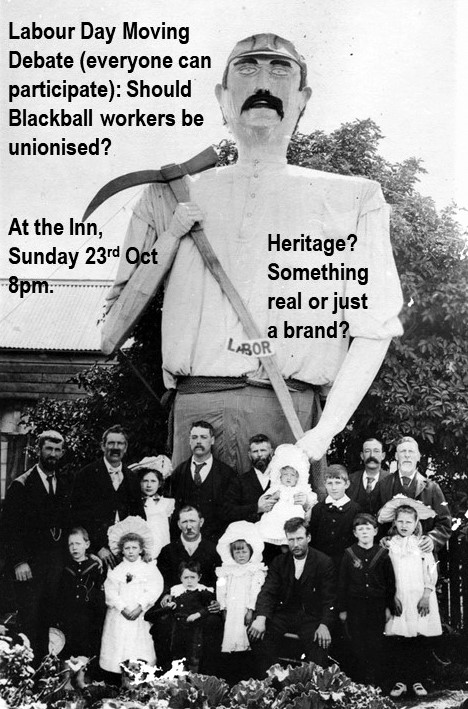
Labour Day, created as a public holiday to celebrate the eight hour working day and other achievements of the worker movement has become just another holiday. To restore a touch of authenticity the Blackball Museum of Working Class History mounted two events in the village. Last night we held a debate on the topic that Blackball workers (those employed in the village) should be unionised and covered by a multi employer collective agreement. It proved to be an intense ‘conversation’.

Those on the affirmative argued the proven benefits of a collective agreement for wages and conditions, the more general benefits of collectivisation in times of crisis and change, as well as the benefits of having a collective voice and a sense of belonging, plus the hypocrisy of a village whose main heritage story is that of worker activism not currently living its union story – except as a brand.

The opposing stories were revealing and based mainly on the blaming of unions for failing to provide solutions in often complex situations. For example, a local school is down to one teacher because of a falling role so the teacher aide inevitably assumes, by default, a teacher role yet is not paid accordingly. Teacher aides were created when mainstreaming of disabled or neurologically different children was brought in. But the position has been paid from a school’s bulk fund so has always been competing with other needs. The drop in roll is caused by a combination of demographic factors: retirees from the cities attracted by cheap housing so as to have a retirement nest egg or to add to the Mum and Dad bank; investors buying houses for Air BnB now the great walk is up and running; further holiday houses now the village is becoming trendier… None of this can be blamed on the union, it is simply the incoherent saga of the market. In fact the teachers union have supported teacher aides’ struggle for better wages and conditions and advocated that they be paid from the department salary budget rather than competing with general school expenses, yet it still somehow gets the blame for the situation. Another story of feeling let down in a redundancy/restructuring situation led to a skilled worker advocating for individual bargaining. A third opinion was simply for peace and harmony – local employers are kind hearted so why create friction; the battles have been won and unions are no longer necessary?

It is strange that anger and bitterness should be aimed at unions rather than at the capitalist system, yet, in reflection, unsurprising, for there was in the Muldoon era a concentrated government and employer campaign to discredit unions, leading to the Trades Hall bombing. And then the Employment Contracts Act era of the 1990s saw another onslaught on the ‘bloody unions causing trouble.’

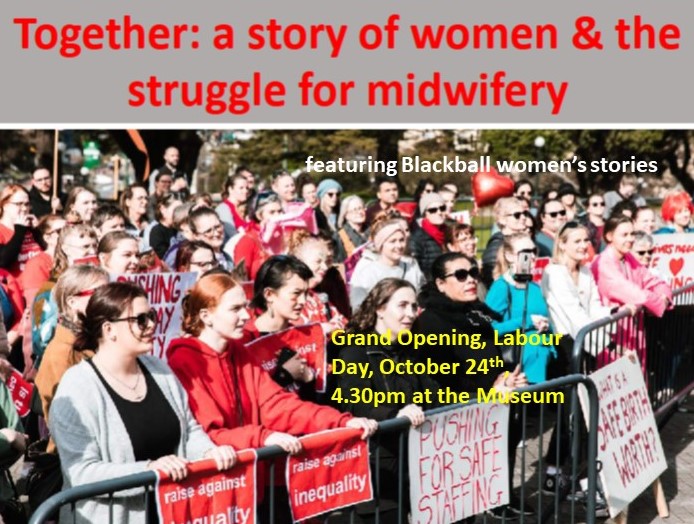
A second event is today’s opening of an exhibition on the midwife story, a story of women achieving an independence from the patriarchal and hierarchical medical control of birthing practice. The Lead Maternity Carer (LMC) system introduced in the late 1990s was celebrated internationally as a progressive model to be emulated. But in setting it up, the midwife representatives failed to include regular negotiation of pay and conditions in the agreement with the Ministry of Health. This has led to a failure of payments to keep up with inflation and a further failure to recognise inequities for rural practitioners and the need for paid time off. A return to union advocacy is required and underway.

As usual I dream of a working class museum existing and these sorts of face to face discussions taking place, in villages and towns throughout the country over Labour Weekend.

Reality Check

Last Saturday evening’s concert by Porirua orchestra. Virtuoso Strings, was an absolute delight. Mainly PI and Maori young people (with some Pakeha and Asian) from Cannons Creek, tackled the European classics, added some more popular refrains and generally charmed the Greymouth audience, for this was culture as it should be; surprising, inclusive, diverse, communal, skilled, and free. This was a hopeful glimpse of the future.

How different from the current hysteria of Coast extractivists, fuelled by testosterone and arrogance, can of diesel in hand, doing doughnuts on the political landscape with regard to their having access to conservation land. How tired I have become of the born and bred mantra; its attempt to silence diversity and above all, its lack of reality.

The extractive industries have not actually developed the Coast, which, after 150 years with extraction as its economic base, languishes as an economic backwater with a sparse population of 30,000 people.

As for the supposed villainy of the Greens, they had nothing to do with the coal mine closures of the 1960s and 1970s, had nothing to do with the restructuring in the 1980s, were not responsible for the demise of Solid Energy, were not responsible for the Pike fiasco, were not responsible for Oceana closing down its gold mine. With regard to native logging, does anyone still think we should cut down every podocarp on the Coast?

Climate Change is a reality. Sea level rise is a reality, The role of fossil fuels in this crisis is a reality. Sixty major NZ companies (over half of NZ’s production base) signing up to a carbon neutral NZ by 2050, is a reality.

Comparing Eugenie Sage and Jacinda Adern to Hitler is politically infantile. We are heading for Trump land.

Regional Council chairperson, Andrew Robb was an isolated voice of reason when he stated that the Coast needs to be part of the solution rather than once again play the victim. The hysterical reaction to that statement belongs on the analyst’s couch rather than the political forum.

When it comes to extraction in all its forms (some of them more hunting and gathering than mining) on conservation estate in all its forms, negotiation will take place, and as local communities living beside and sometimes working on that land, we have a case to develop from within the above realities. But the boy racers should be left in the nearest cell cooling their heels.

Returning to the concert, and bringing this matter up afterward, a mate muttered, Boys with their toys – they’ve had their day. Another was less resilient: I’m wondering why I’m living here. The latter statement is worrying, for it will not be an isolated case. The vision of the extreme extractivists, that the Coast will die, could well become true – and they will be the cause.

Changing Cultures

I was on a jury recently, for a sexual assault case in one of the glacier towns. The trial revealed a tawdry lifestyle: precarious work, transient population, the only belonging to be found in the smartphone screen, the dvd, the facebook message, the porn… Identity is a series of uniforms- the hotel, the bar, the Warehouse clothes, the rugby league shirt, the All Black scarf… They eat a diet of takeaway or bar food. Somewhere in there is a desire for affection, even love and it all goes wrong. Meanwhile the tourists pass through in their thousands, for there is a natural wonder here which they all must photograph.

All pretty grubby and a long way from the culture of the mining towns in their heyday, the Labour-voting, union-belonging, men and women with their sports teams, the camaraderie of the bathhouse, the need for trust, the stories of past struggles for economic and social justice, some of them church goers, a few of them communists, providing their own infrastructure when necessary. Of course I mustn’t idealise the culture – there was a lot of booze involved and it was patriarchal, but compared with the tourist town it had considerable integrity…

Mawhera/Greymouth is in transition, slowly becoming a tourist town. As I hung around for a few days, that was the impression – tourists were probably outnumbering locals. There are signs of greater liveliness. The town square is happening. Stewart Nimmo’s was busy (and he deserves that, after hanging in there for so many years as a local gallery), the Chinese restaurant was full of Chinese – a nice image, a young woman was playing the ukulele outside the library as she learned a new song, there seemed to be more posters advertising shows, and I could sit and have a conversation with a UK couple about Brexit.

The question becomes one of maintaining the local, and not becoming tawdry and transient. This is where there are crucial things to be quickly learned and I’m not confident of this happening. To maintain that integrity while changing requires trusting the local values, building with local materials, involving the community not just to provide feedback but in doing the work, and thus to respect local skills and local craftspeople. So far, that hasn’t happened. The Miners’ Memorial has been literally made in China, and it shows – when the money could have generated half a dozen local sculptures along the flood wall. The start of the cycle trail is boring mock heritage. The town square could have been made locally, with roof supports and furniture made by local artists and craftspeople, the tiles made via community workshops as has been done in Harihari. It could have been beautiful. Instead I’m betting it will all be brought in from outside. Behind this, unfortunately, is a sort of mid Californian aesthetic accepted by councillors and officers as ‘the norm’. It’s the design aesthetic of shopping barns, fast food outlets, sporting complexes, used car lots, prisons and airports.  And it is expensive.

The issue, really, is one of culture. There needs to be a design committee made up of locals with art skills and knowledge of cultural processes, and this committee needs to be led by tangatawhenua. But how is that going to happen? There’s the rub, as Shakespeare might say.

Politics as storytelling

Mayday pic

Dairy worker delegates and organisers with Cuban Ambassador.

The Mayday seminar on the way forward for the Coast economy was designed as a story-telling event, to test whether there is a narrative we can begin to inhabit. The seminar was union led, with the unions being joined on the organising committee by Runanga and Blackball community organisations and the Grey District Council Economic Development Unit. This in itself is a story, which questions whether the discussion is necessarily led by managers and political leaders.

The seminar began with union organisers and delegates reporting from their survey of what Coast workers want? It proved to be a coherent story. The well-organised and fully unionised primary teachers want to retain their collective agreement, don’t want to be individualised by performance pay (instead want a better career path), are fully aware of and will resist corporate attempts to colonise the public system via charter schools and corporate product, and are acting in solidarity with support staff to raise the wages and conditions of these valued colleagues.

The health workers are equally committed to their collective, but are suffering stress and overwork from the underfunding of the service, underfunding designed to drive those who can afford it, into the private sector.

In the government sector and in midwifery, equal pay remains a big issue, as does work life balance. Midwives, self employed yet funded by the state, have only had a 2.5% increase in twenty years.

Those outside the state sector want well paid, secure and meaningful jobs, with career paths available. Not an extravagant  request, but one threatened by the increasing trend to precarious shift work, symbolised at its worst by zero hour contracts.

A cultural worker, who because of the nature of the field, has always worked precariously, stated how a Universal Basic Income would assist people faced with precariousness, as well as pointing out the injustice of arts funding being directed to urban areas.

The story told was a coherent one, of a desire for meaningful and secure livelihoods based in the Coast region.

The politicians and executive officers working in economic development were then asked to respond, this constituting another story. Kevin Hague identified the problem: we focus purely on economics, rather than focusing on the needs of people and the environment – the latter focus should then generate the economic system. But otherwise the response was highly individuated:  visions, personal aims and hopes, institutional charters, with two specific proposals for Buller being mentioned: the wood waste to diesel proposition and the incinerator proposal. But there have been community campaigns in Sicily against their poor region becoming the dumping ground for rich regions’ waste. Will there be community discussion and assessment or is any corporate offer to be jumped at? We seemed to be in a story of fragmentation.

The Cuban ambassador then told the story of the extensive and thorough consultation process (which is ongoing) as that country began to restructure its economy – every strata of society, from unions to farmers to students to neighbourhoods responding to a set of proposed changes.

After lunch three young professionals told their stories of ‘living on the Coast’. Nick was brought up here then left to further his education but has since returned, Elena managed to educate herself while remaining on the Coast (at one stage that required enrolling in a Queensland University on-line course) and Te Whaea has come here to teach. Each of these wonderful young people told of their reasons for living here, the advantages and compromises and their commitment to the community. Lifestyle, access to the natural world are balanced against fewer consumer and cultural opportunities. Affordable housing is a big plus. They reported excellent colleagues and mentoring, but Te Whaea felt the lack of visibility of the Maori story and the lack of multi culturalism (Mayor Tony Kokshoorn stated that funds have become available to tell the tangatawhenua story). But the simple fact that these young people were here, enjoying life and are committed to community involvement was a very hopeful story.

Of course there had been an elephant in the room, the neo liberal master story: that the economy and the political system should facilitate large, usually multinational corporations, to exploit labour, society and the environment in order to return a profit to an increasingly small number of people. We had avoided this story but were reminded of it by Karen Davis as she told of the dairy industry expanding to Chile and China and developing unsustainable farms on the South Island East Coast during the price boom, leading to cows being turned into machines, an inevitable over supply and the inevitable bust (politely called market adjustment), but during which bankruptcies, suicides and community implosions occur. As well, dairy farmers pay very little tax. But we didn’t want (and shouldn’t want) to be sucked into this story.

Three local small business people then told their stories, all equally moving and entertaining: of the creation of the iconic Blackball businesses which had proved sustainable and involved risks, guile and passion, of the absolute integrity of the Garden Shop and its body of skilled workers; of the Putake Honey people, moving from the higher echelons of the corporate world to bee keeping in Marlborough and now the Coast (supported by DWC), because life wasn’t making sense in the flash Sydney apartment. They were stories of passion and commitment, and stories based here.

Finally, there were two possible stories introduced: one the co-operative model developed by the Australian union movement, where union networks provide a committed market for a collectively created product; the other the social enterprise model, where the community organisation grows into a business serving local needs. It is a model which is now at the centre of the economy in many of the marginal rural areas of Scotland.

In the reflection process, there was a feeling of hope, based on the stories of committed people choosing to live here and making that choice a viable one. Damien O’Connor made the point that a change of government is required. It does require political institutions supportive of both collectivism and individual aspiration within that collectivism.

And it was here that there appeared a different beast in the room, the notion that the political party, if you like the story of representation, must originate from within the stories being told, rather than telling a story outside these stories. And of course, the story of socialism developing social democracy was of this nature. As soon as it diverted it disastrously failed. The environmental movement is another such story. Once again, as soon as it diverts it begins to fail.

How this story can be told is another story, yet to be told. Perhaps we could begin with a West Coast charter. Here are some suggestions of what might be in it.

  • That the Coast recognises the special place of tangatawhenua in the history and culture of the region;
  • That the Coast upholds unionism and the value of collective agreements to ensure equity and collaborative management;
  • That the Coast upholds the principles of pay equity;
  • That the Coast values work-life balance and flexible working schedules which contribute to that balance, as well as career paths in all work sectors;
  • That the Coast upholds the public ownership of education and health services, requests adequate funding and that collegiality be preserved;
  • That the Coast, realising an inevitable seasonality in some sectors, the pressures involved in small business and the precariousness that results, is supportive of a Universal Basic Income;
  • That the Coast celebrates and supports sustainable small business loyal to the region and passionate about quality and service;
  • That the Coast celebrates young people committed to the region and to their life here;
  • That the Coast will seek ways and means for a range of online tertiary education to be available to its young people in a supportive environment;
  • That the Coast insists on a regional royalty payment for materials extracted here;
  • That the Coast encourages local processing and the adding of value to materials extracted here;
  • That the Coast recognises the uniqueness and value of its environment and insists on sustainable practices in all areas;
  • That the Coast welcomes investment and corporate ventures but will scrutinise ventures according to the above values;
  • That the Coast in order to rectify the rural/urban divide requests population based access to funding in cultural and research and development areas;
  • That the Coast requests its remoteness and special needs be recognised in the funding of the health and education sectors;
  • That the Coast welcomes refugees from war torn and oppressive regimes and will enter partnerships that enable their transition to our community.

Wouldn’t it be great if such a charter were to be discussed at all levels of Coast society?

Blog at WordPress.com.

Up ↑