Search

PO Box 2 Blackball

Paul Maunder's blog

Month

December 2019

Tragedy

We hear the word ‘tragedy’ an awful lot, for it is used to describe most sudden traumatic deaths, from traffic accidents to mine explosions to house fires to tourist disasters such as the recent White Island event.

As a dramatist I can become irritated at the loose use of the word, which, for me, is most valuably associated with a form of drama ‘of elevated theme and diction with unhappy ending’ to quote the Oxford English Dictionary. Yet the OED gives a second meaning: ‘sad event, calamity, serious accident or crime.’ This then, is how the word is generally used and my irritation smacks of snobbery.

I’m faced with a choice: accept the endless, almost daily tragedies, or see if there’s some connection between the two definitions – can the theatre form which comes from the Graeco-Christian tradition, tell us something about the more general use of the word and vice versa?

According to Raymond Williams, who wrote a very good book on the subject, the drama tradition of tragedy began in the theatre of Ancient Greece when three masked characters separated out from the chorus in order to enact ‘the grievous stories of particular ruling families’ as they encountered the vicissitudes of fate and the judgements of the gods. The stories were both myth and a form of history. In the last century the story of the Kennedy family, for a period, had this quality.

010618-17-Greek-Tragedy-Literature

In the Medieval period the tragic story became more about an individual turning aside from contemplation of God and jumping onto the wheel of fortune and being struck down by ‘sin, misgovernance, pride and cruelty’. We have moved from the Kennedys to the Trumps.

Medieval tragedy

Shakespeare explored the tension between the two spaces.

220px-HamletSkullHCSealous

But with the arrival of the bourgeoisie, the tragic story, writes Williams, becomes more about an individual retaining dignity through a time of suffering caused by moral error, with redemption being possible if that moral error is corrected. Here we could use as an example, the Royal Family and the Diana episode, with a new kind of action, including the idea of poetic justice and the need to restore ethical order and unity after an individual is destroyed. We see the same structure of feeling when people overcome addiction.

18th century

With the late 19th  and 20th  centuries we find a tragic mode which is more opaque, for in this mode, suffering is rooted in the ‘nature’ of man. Suffering is, in fact, normal, evil is all powerful and fate is blind. Ordinary people can do each other the greatest injury because of the ‘cruel and indifferent but also immensely fertile law of nature and life.’ In this world view, nature is all powerful and civilisation is a lie. This is revealed in the turgid tales of the court page but also the horror of the death camps. Faced with this, resignation is the order of the day.

But we are also in the tragic realm of the climate crisis where dissolution and chaos is not an individual or even family fate but an event on a planetary scale with the above belief system leading to the tragic action (or inaction) of denial, with everything reduced to the accidents of blind fate and the only position to take being one of resignation.

In this situation a new tragic story has to be told in order to confront the ‘grievous disorder’ and to find resolution. Enter Greta Thunberg and the climate justice kids, who link the suffering of ordinary people in the developing world and of indigenous people everywhere, to the need for human agency(acknowledging what scientific knowledge is telling us and acting accordingly) and ethical renewal.
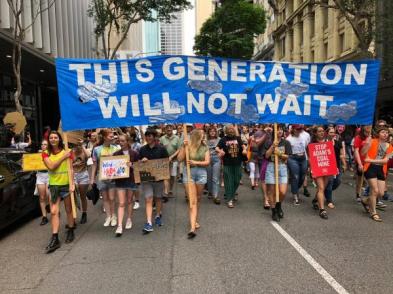
SchoolStrike4ClimateIt It is the grandest of tragic tasks and one in which myth and history or myth as history, are key, which is why their small actions resonate so loudly.

greta

Christmas narratives

When I worked with Sue Bradford and the Auckland Unemployed Workers’ Rights Movement in the in 1990s on a play which told the story of the Rogernomics era from the point of view of the unemployed, we called the piece, Telling the Other Story. The concept of telling alternative narratives has become, since then, increasingly potent.

As the COP25 climate conference threatens to become bogged down at the official level, important stories are emerging: the corporate takeover via sponsorship, the farce of the carbon market, the holding onto power by the north (including Australia), the refusal to consider climate justice at the economic level thus condemning developing countries to becoming survival economies, the anger and creativity of the young climate activists and the prescient voice of Greta Thunberg and the growing centrality of the indigenous voice. Revolutionary change hovers.

Within this is the yet-to-be-forged narrative of a just transition. Here on the Coast it is beginning to happen and it feels vital in order to avoid the urban-regional political split characteristic of the US. Faced with two fundamentalist viewpoints: the extractivist who wants business as usual and the conservationist wanting to preserve at all cost, it is necessary to historicise both viewpoints; to explode the myth of a golden extractivist age on the one hand, but also to introduce the historical trajectory of the conservation come environmental come environmental justice movements on the other. To these have to be added iwi history and process. From this the narrative of a just transition begins to be spoken, then written. Unsurprisingly, the iwi story, focusing on sustainable use of the earth for purposes of survival,  begins to be central.

There has been considerable debate via opinion columns in the local newspaper, pieces which have challenged populist tendencies, critiqued generalist government policies, taken a closer look at market ‘planning’ and finding it obtuse and clumsy, identifying some remaining colonialist structures, unpacked the social construct of ‘wilderness’ by separating the strands of biodiversity, recreation and the aesthetic so that arguments are not conflated, questioned the power and influence of national, urban-based lobby groups and unpacked the class element of tourism. It’s not an easy process, with inevitable falling outs.

Above all, from these narratives, there comes to be a new questioning of capitalism, whether the problems we’re facing either globally or locally, can be solved within free market structures. There is an interesting movement in Europe calling itself the people2people movement, which rejects both the market and the state as frameworks.

The problem in forging this new narrative is the constraint of time, for it has to be written within a couple of decades. Meanwhile, yesterday, I was a member of a community choir singing Christmas carols at the dementia unit. It was both touching and curiously resonant.

Pleasure and Pain

I’ve been reading an old book (one of those with a blank cover and the title embossed on the spine) on the history of economic thought. Interesting and boring at the same time – a perfect night cap.

In tribal times economics didn’t require a thought system. You fed and clothed the family and bartered any surplus. The writer saw the old testament prophets, and we can include the Maori prophets, arising when the tribal system was threatened by autocratic empires.

With feudalism, value was still attached primarily to the land, with the aristocracy wasting their surpluses on luxury items.

But with capitalism arriving on the scene, firstly in the form of bullionism (raping the Americas for gold and silver to add to the state coffers) and then mercantilism (trading companies appointed by the sovereign, holding a monopoly of trade over vast geographic areas), some explanations began to be required, with concepts of utility, value, currency exchange and rules of trade etc. entering the scene.

With the arrival of industrialism and the middle class, both the feudal aristocracy and the merchant class with their monopolies over land and trade had to be supplanted and this was justified by the doctrine of liberalism and free trade. The doctrine is simple and hasn’t changed, except in sophistication. If everyone pursues their self interest, an overall good is achieved. The state has no role to play other than to defend the realm and prevent monopolies arising. If there are no impediments to trade, the system will find an overall equilibrium. Competition will produce a base price for commodities, including labour.

Liberalism, while productive, produces vast inequalities in a society. Along came Marx and the socialist critique, analysing the thorny problem of where profit comes from. Profit comes from unpaid labour, they decided. The worker will work a certain number of hours in order to earn his subsistence, the rest of his hours generate profit for the capitalist, the owner of the means of production. It was an astute and powerful analysis , revolutionary news to the vast majority of the population and had to be countered.

It was dealt with in two ways, firstly by reluctantly accepting some worker representation and some government intervention to provide a welfare safety net, and secondly through an emotionalising of liberalism by seeing work and consumption as motivated by pain and pleasure. Work is painful, consuming is pleasurable. Saving is painful, but increased pleasure will result down the line. Buying a car is painful because it uses a lot of your money, but using the car brings pleasure. Ditto with the mortgage.

Out of this hedonism comes the modern theatre of markets feeling depressed or buoyant, of business and consumer confidence and the continuing castigating of government interference. There is greater sophistication: calculating the relationship of interest rate to investment (lower the interest rate increases investment), division of capital into productive use and investment, the ratio of consumption to savings – the stuff of the daily business report – all of it designed to keep at bay the socialist critique and to justify continuing inequality.

And of course, an ideology based on hedonism hasn’t a hope in hell of tackling the changes required to solve the climate crisis.

pirate

Create a free website or blog at WordPress.com.

Up ↑