Search

PO Box 2 Blackball

Paul Maunder's blog

Category

Uncategorized

Gaza and Satire

Bertold Brecht wrote The Resistable Rise of Arturo Uri, a play which satirised Adolf Hitler as a Chicago mobster, in 1941. Hitler was easy meat, for he satirised himself with his narcissistic performances. But lurking in the wings is the human result of those performances.

The far right Israeli leadership, the Israeli Defence Force and its US backers (with applause from European leaders) – if their acts were not so appalling – are also great material for satire: Joe Biden with a walker and a shopping list pinned to his jacket; Netanyahu running a 10 pin bowling alley as a front for a cocaine dealership with a sideline in arms sales (provided by Joe), the Israeli president in skull cap selling sexy underwear to fundamentalist Arab leaders, radical evangelical Christians wearing angel wings waiting for the rapture in an Arizona desert; Sulla Braverman making a curry from drowned refugees; a frightened teenage Israeli soldier in all the gear entering a children’s hospital hysterically screaming, All men between sixteen and forty put your hands up and take off your clothes and the Palestinian surgeon saying, I am afraid the two acts are contradictory; meanwhile an Israeli actress is being filmed in her role of fake Palestinian nurse pleading with Hamas to stop using hospitals as command centres, the sound technician saying, we’ll dub in explosions later and the director shouting, Cry louder, we need something authentic, as the IDF colonel displays three rusty rifles; the IDF soldier standing in front of a mountain of rubble with a rainbow flag on which is written the word, Freedom – identity politics gone mad.

Unfortunately, while it might seem impossible to take these people seriously, satire does not destroy them. It should but doesn’t. For it won’t stop bombs falling and children dying. But then tragedy wouldn’t stop this horror either. Art is powerless. Even Bansky is silent. For the shopping list pinned to Biden’s jacket is for 15 billion dollars worth of arms for the fascists, to be forwarded without democratic scrutiny.

The horror of Gaza – a Greymouth vigil

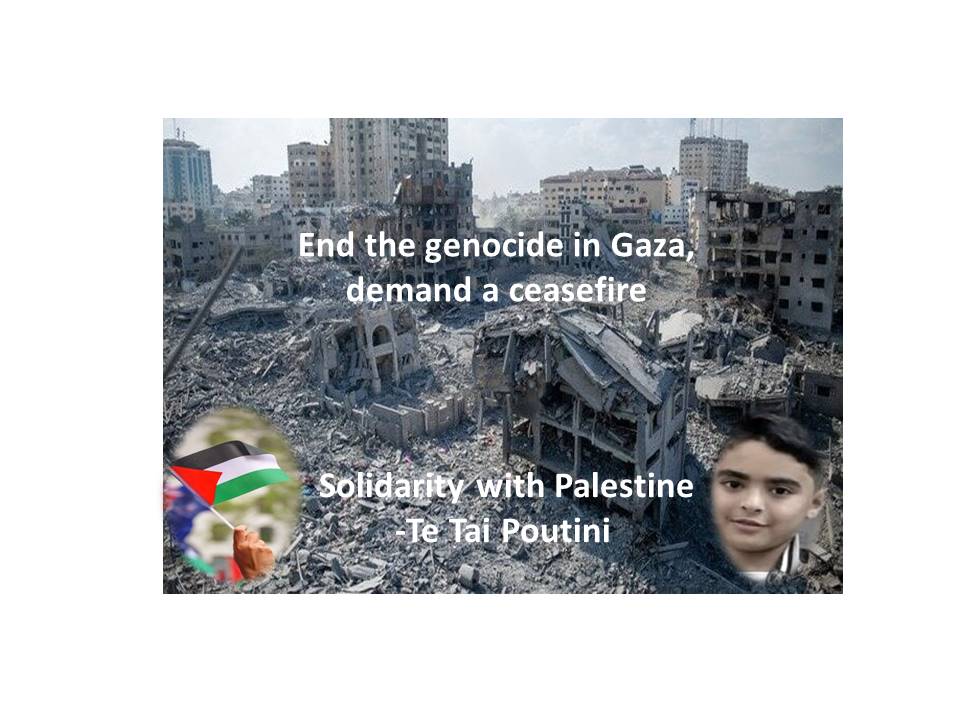
The horror of Gaza escalates and becomes an avalanche of suffering, according to a Norwegian doctor who regularly works there. The injuries, and remember many of the injured are children, are threefold. Firstly there are burns from explosions and there are hundreds with burns to more than forty per cent of the body area; then there are penetrative wounds from bullets or shrapnel; finally there are crush injuries from collapsing buildings.

Burn treatment requires sterile conditions, temperature control, plastic surgery and pain relief.  The penetrative wounds require the immediate stopping of internal haemorrhaging and subsequent repair of internal damage. With shrapnel there are usually multiple entry sites. Once again infection is a constant danger. Crush injuries result in broken bones and possible brain and soft organ damage. As well as repair of the damaged parts, treatment requires flushing of the kidneys to prevent a build-up of toxins. All these treatments require sterile water for hygiene, anaesthetics, pain relief, and electricity to power intensive care units and operating theatres. Under a state of siege none of them are available.

And then there are the more general environmental health issues. Gaza is dependent on water filtering systems which have either been bombed or lack electricity to run, so there is no potable water to drink or wash in. There is massive overcrowding and a bombed sewage system. Infectious diseases like dysentery, measles, typhoid and pneumonia spread. Then there are normal health issues: women giving birth, heart conditions, asthma, the need for dialysis – none of them able to be catered for. There are the mental health issues of a people who have been under siege for years, of families now without homes and children living in constant terror. There is slow starvation, a continuing bombardment and the stench of the rotting corpses under the rubble. Add the fantasies of the perpetrators – of expelling the whole population into the Sinai desert or nuking them and you have the reality of genocide.

It is a truly obscene historical moment (as were the death camps) and the culmination of European colonialism. The hypocrisy of politicians is staggering and it feels like the death of humanity, that species with consciousness, which can and should lead to empathy – the ability to identify with the other. Instead a deliberate obscuring of truth and an obscene accounting takes place. Yes, after years of oppression and humiliation, Hamas started – wrong word, it started a century ago- triggered this ‘final solution’ and there are Israeli families in mourning and desperately anxious for the hostages, but they have water to drink, food to eat, homes to go to and an intact health and communications system. The numbers and the situations are not comparable. Biden reveals himself as a cynical old man, the team serving him morally despicable, the UK and European leaders smiling villains. It is a cesspit of cowardice and Islamophobia. As usual, New Zealand politicians hesitate on the cusp of commitment.

What does one do, living in a rural community where activists are few and often reclusive ‘keyboard warriors’? Put up a poster or two, write letters to the paper, think about a rally which would be sparsely attended, if at all? The tourists pass through, on holiday and avoiding the world’s ills. What act of solidarity is possible? For solitary despair is not good.

In the possibility that there are people out there who feel something of what I’ve described, who are unable to ignore what is happening, I would ask them to meet in the town square for a vigil this Sunday at 6.30pm.Bring a candle and perhaps something for a shrine. We can say a few gentle words and at least collectively pay witness to this horror.

A brief history of brutality

This spring morning,

after a midnight storm,

I walk the country road

under a volatile sky

grieving for Gaza’s children.

Passing the golden broom,

the hustling creek,

the mound of rocks

in the council’s paddock

awaiting the disaster,

I grieve for Gaza’s children,

reduced to rubble.

Primo Levi was an obsessive

witness to the evil of Auschwitz,

taking notes with the diligence

of the chemist.

Would he have considered

the destruction of Gaza to be

the ultimate testimony?

I hurry back to shelter,

before the storm returns.

Gaza

Acts of terror are conducted by those with limited power, against those with great power (usually the state or sometimes a large business conglomerate). The aim is to rip off the mask of the powerful and reveal the violence behind their power. The problem with terrorism as a political strategy is that the state is better at terror than the terrorist. Accordingly, the attack by Hamas fighters against Israel, as well as ripping off the respectable democratic mask (which didn’t need much ripping, it already being in tatters), has resulted in Israel moving from being a proto-apartheid state into it becoming a proto-genocidal state, laying siege to Gaza, bombing its infrastructure including hospitals, schools and residential areas, denying food, water, fuel and medical supplies, and their defence minister wanting to eradicate the ‘animals’ who live there.

Both sides have committed war crimes: targeting civilians and collectively punishing a people, with Israel well practised in operating outside of international law. It is regularly sanctioned by the UN for creating illegal settlements, violently invading Palestinian territorial waters, operating humiliating checkpoints, denying medical attention, bulldozing houses, oppressing its Arab citizens, undertaking illegal surveillance, its snipers killing people as they go about their lawful business, carrying out drone strikes and denying Palestinians access to the outside world. It is no secret that the Israelis train the increasingly militarised Western police forces in how to control a populace; for they are the experts. But now, the normal day to day violence of the proto-apartheid state escalates into the radical violence of a proto-genocidal state.

The actions of Hamas are also illegal and an outrage, but let us remember that they were elected to replace a corrupt, collaborating government and were at their inception, a group practised in community development in Gaza. When elected, their governance was immediately sabotaged and attacked by Israel and the West. If they are now a terrorist grouping they have been made so by Israel and its US backer. And when you make life intolerable for the citizens of the most densely populated area on the planet, for year after year, these people, constantly experiencing grief, hopelessness, hatred and anger, ultimately have nothing to lose and will explode.

Watching this tragedy with the emotions of pity and fear, it is interesting to witness the local reaction, to see the Government’s call for the upholding of international law and for restraint, immediately attacked as too soft by the local Jewish lobby, with its propaganda that Israel is a country upholding the values of freedom and democracy in the midst of a sea of Arab vindictiveness. By some mysterious process those values don’t translate into the governance of the country or into tolerance of international debate. The propaganda is so successful, that if I were in Scotland this piece could possibly lead to a visit from the police. Meanwhile, Western leaders condemn the war crimes of Hamas without equally condemning the war crimes of Israel. Why? Because Israel remains a beacon of colonialism.

Locally, there is either indifference or ignorance, of, if the matter is brought up, a new age response that if we keep putting out bright-eyed positive energy, the problems of the world will go away. When that naivety is in turn challenged, then the response is, It’s not the Jewish people wanting an apartheid state (despite voting for it and continuing to serve in the army and yes, protesting when their own civil rights are threatened), or that it is the fault of bad leaders (all leaders being suspect, but someone votes them in). It’s like Christians existing in a sinful world and praying for the enlightenment of the sinners (and meanwhile Ukraine worries that it will slip from the radar as the chief recipient of the products of the arms industry, with its accompanying profiteering).

Of course there is a sort of street wisdom in this, and a memory of the values at the core of Pacifism, and the willingness to go to jail for those values: that all working people want is a peaceful and just society and therefore we refuse to slaughter one another because of the quarrels of the masters and the profiteers they hang out with.

Let me suggest that it is once again time for a genuine and widely supported peace movement.

Gaza

Gaza blows, surprise, surprise…

You put people in a crowded prison,

humiliate them daily, kill their youth,

call them animals, half starve them,

imprison them, pull down their homes,

desecrate their religion, deny them an

economy, flaunt your wealth and privilege,

and then,

when they explode in hopeless anger

and grief, you increase the terror…

It used to be called sadism.

Election notes

It is interesting to view the election as a debate within te ao Māori. The simple definition of being Māori is having whakapapa, so we have a broad spectrum: David Seymour of ACT, a right wing party wanting to re-situate the tiriti, Marama Davidson of the Greens who are environmentally austere and socially left (capital gains tax, free dental care, guaranteed minimum income); Te Pāti Māori who as well as advocating for tino rangatiratanga are anti royal, anti US imperialism and want NZ out of Five Eyes – they also are socially left, into capital gains and wealth taxes; Winston Peters and Shane Jones of NZ First who are populist and opportunist, playing an anti-Māori card – it was once anti-Asian but Winston goes with the flow of grumpiness – and also focusing on Northland; conspiracy ‘Christian’ oddities like Brian Tāmaki; and then Māori in the mainstream parties, with a Labour Māori caucus probably responsible for the Labour Government’s co-governance strategies and other cultural pushes; and with National Māori members seemingly happy with the National trajectory.

This spectrum is pretty much reproduced within the general electorate, although I would suspect the PI electorate is more Labour oriented and the Asian electorate more to the right and, interestingly, there is no anti-imperialist voice within the general electorate. In fact there is virtually no debate on foreign policy. But generally, I might assume, that if tauiwi were to disappear, a post- colonial election would not be radically different in terms of policy stances. Of course it might be argued that this is the result of colonisation but the infrastructure of colonisation can’t just disappear – it’s a lengthy walk through the alps with a sack of milk powder in the pack.

In which case I am left with the tiriti and an indigenous past which can become romanticisms, but which, instead, could become catalysts for the emergence of a post-capitalist culture of revolutionary change.

Honoured

Attending an investiture was formal and grand. The ceremony invests people with attributes and qualities, giving them the dignity of worth and excellence. There are grades or ranks of these attributes and a citation to support the decision, which has been made by the warrant or the authorisation of the head of state, in this case the King through his agent, the Governor General.  A medal is given to the recipient, plus a copy of the warrant. Letters appropriate to the rank can be used after the recipient’s signature and those of highest rank can use a prefix to their name (Sir or Dame).

It is a carry-over from feudalism, where inheritance of land brought power and authority over the people who worked the land, plus the delegated power of the sovereign in the local courts and in tax collecting. In return there were obligations to provide some infrastructure – roading, relief for the poor, medical services plus soldiers in the event of war. The common people had to accept the powerful person’s merit and excellence and here God was the ultimate judge. This meant that the church as interpreter of God’s voice came into the equation, which often generated some tension.

With capitalism, possession of money and that which money can buy, provides the guide to merit, importance and worth. Important people are wealthy and the poor lack merit. The working class sell their labour and their merit is a collective one expressed in the value of solidarity. It is a much more naked society and money, and the accompanying merit, can quickly come and go and be more generally contested.

The grace of the sovereign and his orders of merit giving worth and dignity is then a useful nostalgia to cloak the nakedness. In Aotearoa, there is, as well, an easy melding of this nostalgia with the Maori cultural renaissance, leading to a more democratic recognition of mahi and mana. The contradictions of king and church and feudalism still hover, but a more benign indigenous voice can be heard.

As a recipient I find there remains the discomfort of the singling out of this or that person, who has often been working in a collective, community milieu, and a singling out which depends on the almost accidental energy required for nomination by a colleague or friend with time and energy.  On the other hand, the recognition of community activist energy, rather than the more normal tribute to those who have ended up in powerful positions in the judiciary or military, or to capitalist patrons, seems worthwhile.

Finally, a working class family felt proud.

Continuing…

A positive response to the TINA blog led to these further thoughts.

Capitalism is of course a system of production that requires capital rather than land. But capital is not neutral. Iwi capitalism, for example, has a collective purpose and collective values behind ventures which perhaps explains its current success. Jews and Lebanese have been renowned entrepreneurs. Traditionally, religious organisations and their members, especially the Brethren and even the Quakers, have been successful in business (Cadburys, Sanitarium…), And then there is the national brand: Jaguar, Volvo, Mercedes Benz, Fiat, Toyota, Holden… This suggests that the capitalist impulse is not purely investment driven, which is why the application of a narrow set of tools by CEOs working for local bodies or NGOs is counter-productive.

And then there is the fact that capitalism remains dependent on colonialism and the exploitation of labour and resources. Locally we have the use of PI labour in horticulture, iwi fishing interests were chartering Russian fishing boats that exploited Filipino labour and reluctant to stop the practice. There is the continuing exploitation of African resources and labour.

Union collectivism has inserted the interests of workers into the structure, with some success, but as has been pointed out, first world worker gains piggy backed on exploited colonial labour.

     There is the issue of the seeping of capital ownership into individual lives through home ownership plus contents, car, caravan, boat, kiwisaver and other investments. There is the issue of unpaid care across all sectors – bringing up children, food preparation, caring for elders etc. There is an ongoing issue of technological advances taking no notice of social context or impact and creating stress at every level of society.

      And now the climate catastrophe is the elephant in the room and the question of whether market forces and capitalist tools can in any manner, solve it.

     The proposed Marxist resolving of these contradictions through the taking over of the means of production, distribution and exchange by the diverse working class (and we might add the peasantry, ethnic groups,  intellectuals and cultural workers) as an exploited majority with values of solidarity and equality remains problematic as actually practised, for it has generated issues regarding the roles of the state, the family, religious belief, intellectual and artistic freedom and responsibility, unions and ethnic groupings. It has always required a revolution with a difficult aftermath and questions of whether the necessary changes are played out locally, regionally, nationally, even  internationally.

       All of this, or none of it, was sitting on the table when I went to a candidates’ meeting in Greymouth yesterday organised by Grey Power and the Anglican Church. All the candidates were there, plus at least a hundred fifty locals. It was an old fashioned town hall meeting and had a good vibe. It was tightly run by the local vicars: a four minute opening pitch by each candidate, followed by a selection of questions that had been sent in (and in turn sent to the candidates so they could prepare their response) – some of them Yes/No questions, others requiring a two minute response. Time keeping was strict and no raving from audience members was tolerated.

          There were questions of level of investment in health and education, local body funding, the Waitaha Power Scheme, crime, problematic youth, mental health, Pharmac, cost of living, unemployment and benefit levels. Unsurprisingly the issues were about families getting by. Presence and personality became important factors.

         The independent candidate surprisingly appealed because he didn’t have the veil of party policy to peer through. He’d been brought up on the Coast and stayed here, worked in a number of sectors and felt that the Coast has a number of resources but is not allowed to use them. All his mates have had to go elsewhere to work and that was wrong. He wanted a cradle to grave region and it should be possible. What it needed was a candidate focused on local issues. Interestingly, this is what happens in the Cuban system.

         Sue Grey, the renegade lawyer was the most charismatic presence in the room as she talked of local autonomy and the role of community in solving its own problems: mutuality is possible if freedom is embraced. Of course, if you look at her career, the impulse can easily move into cult association, opportunism, charismatic leadership and subjective beliefs tending toward conspiracy.

         The ACT party candidate, a young Veterinarian and a newcomer to politics had been very well trained in a short period of time and impressed as a Puritan really. Perhaps that’s ACT in a nutshell under David Seymour, old fashioned Puritans getting rid of frivolous spending and native drum beating.

         The NZ First candidate is a regular and seemed quite like Winston – disgusted with things and promising to sort them out. Damien for Labour was weary. I suspect they’ve given up. But they probably also sort of know what things are about by now, but can’t really articulate them. He said one thing that struck me: the key issue for the Coast (and elsewhere of course) is maintaining a resilient infrastructure, in particular the road connections, in the face of extreme weather events. That’s pretty basic.

         The Green candidate was a bit like a relief teacher trying too hard but did suggest that when it came to the youth mental health crisis, the climate emergency was a factor. And finally there was the No Money Party candidate who’s become a fixture at every election, national or local body, suggesting capitalism is the issue but mystifyingly, jumping straight to the utopia of, ’to each according to their need and from  each according to their ability’, but without a path toward that ideal.

         But unwittingly, in a clown like fashion, he almost put on the agenda the issues that were not on the agenda: the structure of capitalism; the frustrating attempts to organise around it, within it, against it; the continuing colonisation, the climate catastrophe; and an increasingly dangerous global order. But that would require a different sort of meeting.

There is no alternative!

Spending an afternoon with CEO’s as a token union representative, I realised the mantra of Reagan and Thatcher has not gone away or diminished in volume. The formula is simple: capital flows to where a profit can be made and favours the sites of greatest return. Government investment can sometimes persuade a softer option but that is frowned upon as a distortion of the market. Accordingly, housing will be built or not built according to market forces and there is no other way – despite the housing crisis. The market is law. If the climate is going into the abyss, a charge on emissions is the only way out; simply factor that cost into the market.

There is some small room to move in terms of sustainability, climate and social justice – for these can be seen as gaining social licence, creating staff loyalty (I work for an ethical company), and meeting customer expectation. Equal pay would come under this, but not unions – unions remain a minor irritation (they used to be a major one but that has been dealt to).

There is no possibility of considering other economic or social relations; their minds are closed – presumably through their education and subsequent training. It is similar to the old USSR and I wonder, given the current stresses, how long before the collapse occurs?

Create a free website or blog at WordPress.com.

Up ↑