Search

PO Box 2 Blackball

Paul Maunder's blog

Category

Uncategorized

Class Struggle

P1060271

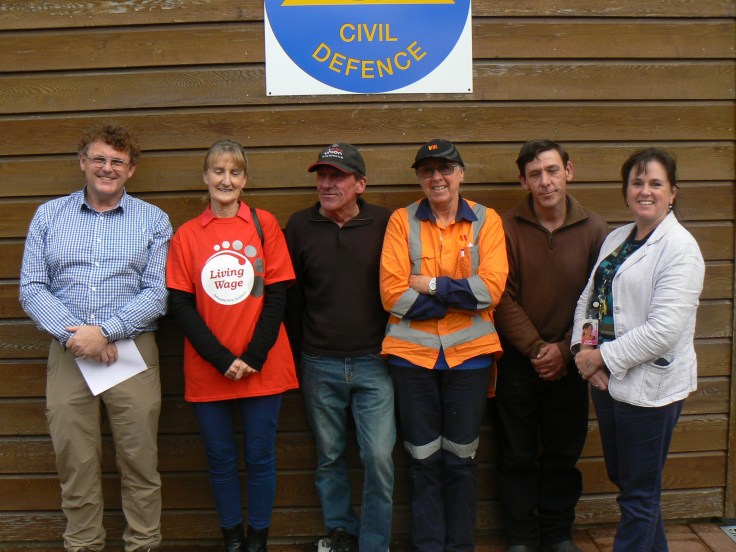
Locals about to enter the struggle

Class struggle: An old fashioned title and an old fashioned concept, side lined currently by the weekly increase in the number of gender possibilities.

But in an age of growing inequality perhaps class struggle remains relevant?

Unions West Coast and the Mawhera Ministers Group went to the Grey District Council’s Annual Plan with the proposal that they research what it would cost for the Council to become a Living Wage Employer, and then consult the ratepayers as to whether they might bear the cost, which by our estimate would not be large. Such a move, as well as providing the proven benefits of increased productivity and less staff turnover, would have a reputational benefit, with the Council being seen as progressive and up with the go-ahead cities, rather than red neck and conservative. It would of course also provide an example to local employers.

The Living Wage Movement is interesting politically. It’s not advocating under a party umbrella, or a union umbrella, but seeks a broad coalition of community groups in each locality to argue the case. And the case is to a large degree, an ethical one.  Employers should pay a sufficient wage for families to have enough to live on.

And the Living Wage case has been well researched. The concept is based on a ‘normal’ family of two adults and two children, one of the adults in full time employment, the other in half time employment. They now need $20.20 an hour to cover their costs. It means that if they are earning the minimum wage they are $300 a week short. That’s a considerable sum. Of course poverty is relative, but nevertheless poverty in New Zealand is leading to homelessness, overcrowding, malnutrition, health issues, the reappearance of diseases like TB and rickets, children deprived of educational opportunity, chemical abuse, family violence and criminality… All this is well known and statistically verified.

It would seem hard to argue against this case. Can you really advocate that families should not have enough to live on? Yet Council rejected our proposal. ‘It is not Council’s role to intervene in the setting of the minimum wage and Council relies instead on the market.’ Suck that up.

Well, we did and discovered that there had been another submission on the Living Wage, and one we hadn’t noticed: from the NZ Taxpayers Union. This is an Auckland-based lobby group set up by people to the right of the ACT Party. They are obviously worried about Councils getting involved in this Living Wage nonsense and have done their own ‘research’ which they are now presenting to Councils up and down the country. They have decided that the Living Wage concept is flawed. Here’s why:

If you raise low wages ‘artificially’, it will mean higher-skilled people rush in and take those low-waged jobs and then there won’t be work for low-waged workers. Quite an argument. Don’t abolish slavery because then all those free whites will want to work in ‘dem cotton fields and there won’t be any jobs for the black folks – or the illegal migrant or the backpacker on a working visa…There won’t be work for those people who milk the cows, tend the grapes, pick the apples, collect the rubbish, clean the office blocks, serve the coffee, wait the tables – for the higher echelons of society (the teachers, nurses, doctors, engineers, managers etc) will be rushing to take their places. They also throw in the perennial neo liberal argument that bodies funded by rates or taxes and therefore not being disciplined by market forces, have no business distorting the market. It would be better of course if they didn’t exist at all.

What is most alarming is to realise that the Grey District Councillors, all of whom are local business people, accepted this nonsense rather than the Living Wage argument, and did so for class reasons. They are there to make sure Council looks after their own interests. As employers they have no wish for an example to be set. But at least  they have revealed their politics, and can no longer hide behind a ‘service to the community’ mask.

Battling these people and the class tendency they represent is what is meant by the term, class struggle. To summarise: while the gender issue may be rolling down the highway, the class issue hasn’t moved an inch.

Heritage

I spent an hour last week listening to the oral submissions to the Grey District Council regarding History House, the nearest the town comes to having a museum. It is funded by the Council but run by a group of volunteers who oversee a big collection of photographs which have been donated, plus some objects. It has been located in an old building down by the wharves and the building is both out of the way and has been judged an earthquake risk, so has had to be closed to the public.

Estimates vary as to the cost of getting it up to standard but they tend to be in the $300,000 range. It is the only cultural institution to be funded by the council but visitor numbers have been low; it’s out of the town centre, perhaps difficult for visitors to find and its exhibitions don’t change. There has been no curator or curatorial function.

The local I-Site, run by a capable entrepreneur, proposed to the council that the I-Site take over the running of the facility, move it to an empty shop by the railway station where visitors disembark daily from the popular Trans-Alpine train, develop some souvenir type product for sale, extend opening hours and make it ‘modern’. The council accepted the proposal and were now hearing submissions.

However, most of the people speaking were against the idea. By handing it over to business interests, it is commercialising the town’s heritage. It will lead to the probable demolition of one of the few old buildings remaining. The volunteers who have given generously of their time feel betrayed. Donors will object if money is being made from their donations.

Sartre has the concept of the practico inert, the dead weight of the past and I felt this as people tended to ramble on.

The I-Site manager told the meeting he had made the proposal in good faith. Business is about location. No one goes to the present place because nothing changes. You go once and that’s it. The volunteers have his respect and they can still be involved. Here was a man with the praxis of business, born from the need to make a profit or at least break even.

I was there to speak of the need for the curatorial role to interpret a collection, to enable an ongoing dialogue with whatever is happening in the community. But on this occasion I certainly felt like an incomer, an outsider.

Heritage is a bemusing field. There’s an interesting book I made a contribution to: Heritage, Labour and the Working Classes, published by Routledge in 2010. One of the writers states that heritage was once focused on architecture and archaeological sites: the old, the beautiful, the great and the good – castles, cathedrals and Stonehenge. It was a matter of celebrating in nostalgic fashion,  past economic and cultural elites. But of late, given the demand for diversity, it is a much wider field which encompasses ‘places, artefacts, and cultural expressions inherited from the past which reflect nations, communities, families and even individuals.’ But it has also become a field that ‘defines the disturbances, irregularities and uncertainties of the present, much more than it truly represents the past.’

This is certainly true of History House. Faced with the need to move to an economy based around tourism and dairying rather than extraction, Greymouth/Mawhera has to embrace the visitor. It has no great natural attraction so is relying on its ‘heritage’. After the train trip how do we get people to stop in the town rather than immediately heading off to the glaciers and Queenstown?  The council and the I-Site see an opportunity, but the traditionalists are nostalgic, sensing that the museum’s ability to validate the community and families and local individuals will be lost.

There is no easy solution and this ‘disturbance’ will continue to fester. This is where the curatorial role will be vital: to validate the community in a way which is of interest to the visitor, who is often after a genuine cultural experience rather than a souvenir. The souvenir, if you like, should come at the end of that experience rather than being that experience.  But curators are expensive. As I said to council, there are people in the community who could curate an exhibition on a koha basis. If you can make a film you can make an exhibition.

There is as well, a structural problem to be solved: not just a business, not just a community group of volunteers – what about a co-operative with the stakeholders (including the I-Site and the Friends, plus Heritage West Coast, Greymouth business etc) becoming  shareholders and the council as patron? This could drive a road down the middle of the muddle and become a win-win situation?

Art and Palestine

I’ve been feeling guilty about Palestine. I have to admit that, of late, I have deleted without reading the e-mails from the International Solidarity Movement, from Gush Shalom and from the local network—what’s the point of reading daily the latest report of the hunger strike, the latest house demolition, the latest new settlement, the latest ignoring of the latest UN Resolution, the latest shipment of US weaponry to Israel, the latest boat turned back, the latest fishing boat shelled, the ongoing water crisis in Gaza, the ongoing lack of building supplies, the latest suicide attack. What can I do? I can’t divest or boycott. I felt a moment’s pride when Murray McCully put forward the UN resolution and ‘declared war on Israel’ and then, more recently, a moment of shame as Gerry Brownlee  corrected the aberration.

I still feet a moment’s anger when some dumb opinion piece appears in the newspaper or on radio. But that’s the problem with outrage. It’s hard to sustain.

I was in Christchurch for the weekend. I borrowed a friend’s car and there was a CD on the player which immediately grabbed my attention as I negotiated the traffic to the nearest mall – Christchurch shopping now seems to focus on malls. I listened with rapt attention as a young Palestinian woman chanted intense monologues with a musical backing, each one exploring a contradiction: gaining Canadian citizenship by swearing allegiance to the Queen; or preparing for the dumb press interview as Gaza is bombed, knowing that a sound bite is all that you’ll get; or rehearsing answering the dumb interview question: Why do you teach your children to be terrorists?’ This gave the CD its title: We Teach Life.

Listening to her I was struck by the power of art to restore feeling. The last time this had happened for me with regard to Palestine, was reading the emails of Rachel Corrie. Both these young women embody in words the outrage with creative skill. The thought has feeling, the feeling has thought. This was Brecht’s definition of art.

The young woman I was listening to, Rafeef Ziadah, was born in a refugee camp in Lebanon. Palestinians born in Lebanon do not gain Lebanese citizenship so remain stateless. Somehow she got to Canada and eventually gained citizenship.  Corrie made the reverse journey, from the US to Gaza. If you google Rafeef Ziadah you’ll find a couple of clips of her performing her poems.

My friend in Christchurch also had a copy of a BBC drama series, The Promise, made in 2010. It cleverly plots the Palestinian tragedy. The grandchild of a dying grandfather, who had been a British soldier in Palestine, ‘peacekeeping’ prior to the UN resolution of 1947 which divided the country, discovers his diary. In the diary is a house key which he had promised to return to a Palestinian he had befriended. This sulky anti-hero granddaughter has an Israeli friend resident in the UK who has to return to Israel for her military service. She accompanies her friend and as she searches for the family to whom the house key belongs she encounters the contradictions and oppressions of the modern day conflict, ending up in the hell of Gaza.

Once again art made the issues accessible in a way political action cannot.

But of course art isn’t political action, simply a prologue to action, and, on these occasions, serves as a replenishment.

I’ll now open the emails.

Betrayal?

It has been a strange week on the Coast as the possibility of the Council logging in the forests it owns has escalated into a replaying of the Timberland’s fiasco which took place in the 1990s. The same opportunism and muddled thinking has been present with the same tendency to subside into bitter victimhood.

It is timely then to do a quick survey of the economic facts behind the ‘betrayals’ of the Coast working class. Initial Pakeha economic life down here was a mix of opportunism and exploitation. The adventurer gold seeker occasionally made his nest egg but most did not. Settlements came and went but so quickly there was little grief. Meanwhile the service industry of hoteliers, saw millers, food suppliers and transporters did better, with some of them staying on to become local small capitalists.

aerial001

With coal mining a more robust conflict of interest between overseas business interests and local workers gave birth to a union movement. The Great Depression then enabled a combination of destitute workers, farmers and small business people, producing the social democratic welfare state. There followed a period of state ownership of major infrastructure and relative stability – the golden age for the Coast.

But the switch from coal to oil and electricity led to the first round of mine closures in the 1960s and a sense of betrayal as communities struggled to survive.

With Rogernomics, this downsizing continued with layoffs from the remaining state-owned mines, the closure of sewing factories, the disappearance of local potters, plus the downsizing of government departments like the Ministry of Works and Railways and the turning of them into State Owned Enterprises. Once again this put huge pressure on regional communities.

P1010740

And then in the late 1990s, the stopping of native logging in state owned forests and the rejection of Timberlands’s sustainable beech scheme was seen as yet another betrayal. A  surge in the price of coking coal saw a momentary boom in coal mining before the Global Financial Crisis caused a drop in production in China. As a result Solid Energy collapsed. Further betrayal. Neither Timberlands nor Solid Energy had played a good hand economically or politically.

P1040003

In the face of these crises, the tendency on the Coast has been to play the role of victim – and often the Greens are focused on as the persecutors. Whereas, in reality, capitalism, with its incessant technological change and its desire for growth as it pursues the single goal of shareholder profits, has caused these betrayals. The Greens have simply pushed for environmental care and sustainability in the face of capitalist-led pillaging of the planet. They can lack understanding and often come from another culture (urban, middle class, educated and privileged), but as conditions worsen with growing income inequality, precarious work and environmental crisis, the oppression begins to be shared. We are all in the same boat, like refugees heading across a dangerous sea to an unknown destination.

I remember a Mayday perhaps five years ago when we asked the Happy Valley protestors to debate with the miners. Both parties were anxious, the protestors because they knew they should have talked to the community, the miners because they thought they might punch the protestors. Instead, as the debate proceeded, both parties realised they shared a common enemy: global capitalism.

This revealing and resolving of contradiction is what is required in an election campaign, rather than branding exercises.

Unfortunately we will be stuck with the latter.

May Day

The Blackball May Day event is always an intense experience. In a way, a year’s political debate is packed into one day. It therefore takes a lot of processing.

This year we focused on the Memorandum of Understanding between Labour and the Greens and the contradictions that arise from this on the Coast, in particular, from the legacy of anti-Green feeling that has been inherited from the native logging saga which has then bled into the coal mining issue. Damien O’Connor and Julie Anne Genter were invited to address the issue and that was followed by a discussion on the role of environmentalism (and the environmentalist) on the Coast.

I was left though, with both confusion and a certain disappointment, which I think could explain voter apathy. It is systemic rather than any individual’s fault – all our speakers were very capable politicians.

All political parties at election time now operate within commodity culture. They focus on their brand: their appearance, the easily processed message, and the logo are all important. It’s the way that corporates operate: the product or service is secondary unless there is a big stuff-up such as United Airlines roughing up a passenger. Of course, this is to be avoided, but otherwise associate the brand with good feelings, in the same way that family life or owning a car should promote good feelings. Look at the ads: comfortable surroundings, likeable and healthy people, happy children, able to achieve goals and so on.

The parties will try and tarnish the opposition brand or simply have a smarter promotion. This process requires information about the customer or comsumer, data which is much sought after and collected in a variety of ways, then processed usually through a programme called Nation Builder, which can then spit out phone numbers and addresses and other details of likely voters or consumers of the Labour or Green or whatever brand. Contacting these voters via call sheets and speaking to a set text can produce further data which enters the system. The contact is designed to register whether the consumer remains loyal or is ambivalent. If ambivalent further contact may be useful. And finally, there is the reminder to vote, to ‘consume’ the brand on election day. Feeling alienated?

Meanwhile the campaign has to be staffed and funded by people who are loyal enough to the brand to become active workers, fund raisers or financial contributors. Or who see the possibility of becoming a paid worker or an MP. Prior to election year, these people can be active in policy formation, that is, the content of the brand, but the election is about selling the brand, not changing it. And of course, in the shadows are the big donors.

It means, that in the election cycle, there is room for information, but no room for thought, certainly no room for analysis of contradiction. But contradiction, if not tackled leads to passivity. How can you have two oppposing impulses and act? You remove yourself, if possible, from the situation.

Meanwhile, the polling, the testing of the brand’s reception, is incessant, with parties, like corporations, getting rid of offensive or off putting content. The populist politician might cultivate discomfort as a brand and if that discomfort and discomfort with the consumer process escalates into alienation, might generate a brand which is fundamentally hostile to the system as it is. Then the system has to contain this escalation and usually manages to do so.

So, we were left little wiser about the contradictions that follow from the MOU and this seemed a pity

, for the contradiciton is actually based on a false belief. The loss of jobs on the Coast has been caused primarily by neo liberal market forces and technological change, not by environmentalists. This becomes a new contradiction, which I will explore next week.

Dogs

Dogs

My daughter, Te Whaea, introduced me to a community dog walking group in Greymouth. Whaea has always been a dog person. When she was a toddler we had a Collie bitch who sired numerous litters which were cared for in a small wash house. Whaea would spend hours sitting with the pups and even now the fetid smell of a puppy litter is her favourite perfume.

Her current dog, while very close to her immediate human family, has lacked social skills with other dogs and people, growling at them when approached, so she has joined this group in order to socialise her. She suggested I come along.

The owners and their dogs assemble in the dog exercise area in Cobden at 10.00am on a Sunday morning. Church time. There are most shapes of human beings and most shapes of dogs, although being Greymouth, there are not many pure breds. There are a couple who run a kennel who organise the event and who are expert at diffusing any trouble. But twenty to thirty dogs manage to get on pretty well as they bark a variety of barks and wag a variety of tails, before racing around after a couple of balls. There’re a lot of Collie crosses, a couple of large dogs and one of those squashed ones that snuffle a lot. The owners talk about the weather or the dogs. Last Sunday there was a campervan with a dog on board who paid a visit. They wanted to know the cost? Koha. Blimey, we went to one such outfit in Nelson and they wanted twenty bucks.

We put the dogs on their leads and walk down the road, past the Wetlands that are being restored, past the speedway track, along the shore where freedom campers loll in the sun, and down to the beach. A couple of surfers paddle about like seals and it looks blissful. The thirty dogs, playing in the surf, all chasing a single stick, is a remarkable sight. Sun, sand and sea, misty hills in the distance. We stand and breathe. The French election is a long way away. On the walk back I talk to the kennel owners about the trip they’re about to take to the UK. They’ve got Geordie relatives and an old Aunt in Wales. Plus they’re looking up some Irish family roots. Whakapapa.

I realise this is a city experience, something I can miss on the Coast – that encounter with the stranger with no strings attached. You learn a little about someone, share a momentary shared purpose, even exchange something that’s of concern, but then return to one’s own sphere. It’s different from chat with a shopkeeper, or chat with the visitor from elsewhere, for one knows the person encountered is a fellow resident. Perhaps the dogs feel the same? Perhaps that’s the essence of dog society? Anyway, it is non digital, full of sound and smell and touch. And costs a few cents.

I’ll keep going.

Easter

The Easter story is a remarkable one, but overshadowed in Alexandra (where we were visiting grandchildren) by the annual rabbit hunt ending in a corpse-strewn domain, a fair, the Clyde food and wine festival, and an Easter egg hunt for the children where it was reported an aggressive child could score a pillowslip of Easter eggs.  Faced with this, the story of a crucifixion and resurrection occurring 2000 years ago had an uphill battle to be heard.

I’m not a religious person but, nonetheless, one of my favourite books is a study of mysticism by Evelyn Underhill, first published in 2011 and reprinted several times since. The book was gifted to me by Malcom Yockney, who I went to school with and who wrote in the front cover, Love and friendship always. It’s a scholarly but beautifully written work in which Underhill claims that mysticism is the essential religious experience. She collates the recorded experiences of the great Catholic mystics: Francis of Assissi, Catherine of Siena, St Teresa among others, as well as drawing on William Blake and Walt Whitman. She sees the artist and the mystic as bedfellows and reading of the mystic way offers solace in an increasingly crazy world.

I happened to be reading it for the third time this Easter and was struck by the simplicity yet complexity of the process. The mystic, after sensing God’s presence (the Real), embarks on a journey. The first stage they call Recollection, but it is actually the first meditative experience, the focusing on a single external object in order to cut out the noise of the mind – the fragmented thoughts, worries, anxieties etc.; the rabbit hunt, the wine and food festival, the Easter egg scramble, Donald Trump… The single object could be a flower, a tree, a creek, some representative of the creator. After practice in this discipline, the mystic enters a period of Quiet, where the relationship with God is established, with God being both external and internal. Underhill believes Christianity has produced mystics in relative abundance because of the complexity of the trinity: Father, Son and Holy Ghost- which enables rich relationships to be forged.

Finally, a Unity, a oneness with God is experienced, not as a passive state, but as an active relationship which then spills over to an active relationship with society.  She despises the passive ascetic.

It seems to me, that this model is useful to the 21st century dilemmas. For behind it is the quest for the Real, the authentic, the vital. Surrounded by an extraordinary flood of the unreal, that quest is indeed a useful one. And to then develop a relationship with the Real, in whatever form that might take, is again, useful. Finally, to live in harmony with that Real. And the Real could be a narrative of social justice, it could be whanau, it could be community, it could be the creative project. And to energise that relationship with love.

Anyway, that seemed to be the hidden pattern of Easter for me. I was reminded of a moment in the 1980s when after spending Easter rehearsing Te Tutakitanga I Te Puna at a marae in Ruatahuna, we were driving back to Wellingotn and stopped for a break on the shore of Lake Taupo. Surrounded by motels, boats, cars, it was like glimpsing the Pakeha world, this overlay of capitalism, technology and alienation, from a traditional Maori perspective.

The search for the Real remains fundamental.

High Art

Living on the Coast it is a relief to be able to avoid the middle class art event. But just occasionally it is useful to remind oneself. Having a gift voucher for the Regent, we went along to a video recording of the National Theatre Production of Harold Pinter’s, No Man’s Land. It proved to be a Hunger Games sort of event. Here we were in the remote provinces having a look at what people in the centre are up to. There was the extraordinary atmosphere of importance which the initial spin gave: the skill of the set, the props – even the butter, the lighting, the makeup, the actors talking of how great it had been working together… all this introduced by a woman of Middle Eastern appearance to make this very white event politically correct. This was high art, mate, and we in Greymouth were having a peak- thanks to modern technology.

The chatter ceased, the lights dimmed and we watched  two old men stuck in a room talking past each other, inhabiting what Raymond Williams calls, ‘the negative group’. At a certain point in bourgeois society, the alienation that capitalism produces became so severe that communication was no longer possible.  Fair enough, but in that case, better shut up and let the working class have a go. But if you own the theatre, then no, better keep trying to speak of how important you trying to speak, is.

The acting was not that good, the actors playing their adjustments (in Stanislavski’s term). If I drank that much whisky that quickly I would be in hospital, so a sense of reality was not useful. Two young blokes turned up and provided a bit of threat, but one of them didn’t know what to do with his hands (an amateur theatre problem). Pinter once said, I take people I don’t know and put them in a room and try to think what they might say. It’s a strange writerly experience – I tried it once and won a prize. Anyway, the experience was all so English – the Europeans would have made something philosophical or political of this, but the English just maunder along, assured of a previous imperial importance.  I was reminded of Tony Blair. Meanwhile, the audience tittered occasionally at rather obvious jokes and were having a cultured experience.

I suspect the budget for the production would have been something in the vicinity of the cost of Greymouth’s new town square, which we went along to after Act One, to have a more pleasant cultural experience sitting on the grass in the afternoon sun, listening to a local lass sing, very humbly, a few of her songs.

Changing Cultures

I was on a jury recently, for a sexual assault case in one of the glacier towns. The trial revealed a tawdry lifestyle: precarious work, transient population, the only belonging to be found in the smartphone screen, the dvd, the facebook message, the porn… Identity is a series of uniforms- the hotel, the bar, the Warehouse clothes, the rugby league shirt, the All Black scarf… They eat a diet of takeaway or bar food. Somewhere in there is a desire for affection, even love and it all goes wrong. Meanwhile the tourists pass through in their thousands, for there is a natural wonder here which they all must photograph.

All pretty grubby and a long way from the culture of the mining towns in their heyday, the Labour-voting, union-belonging, men and women with their sports teams, the camaraderie of the bathhouse, the need for trust, the stories of past struggles for economic and social justice, some of them church goers, a few of them communists, providing their own infrastructure when necessary. Of course I mustn’t idealise the culture – there was a lot of booze involved and it was patriarchal, but compared with the tourist town it had considerable integrity…

Mawhera/Greymouth is in transition, slowly becoming a tourist town. As I hung around for a few days, that was the impression – tourists were probably outnumbering locals. There are signs of greater liveliness. The town square is happening. Stewart Nimmo’s was busy (and he deserves that, after hanging in there for so many years as a local gallery), the Chinese restaurant was full of Chinese – a nice image, a young woman was playing the ukulele outside the library as she learned a new song, there seemed to be more posters advertising shows, and I could sit and have a conversation with a UK couple about Brexit.

The question becomes one of maintaining the local, and not becoming tawdry and transient. This is where there are crucial things to be quickly learned and I’m not confident of this happening. To maintain that integrity while changing requires trusting the local values, building with local materials, involving the community not just to provide feedback but in doing the work, and thus to respect local skills and local craftspeople. So far, that hasn’t happened. The Miners’ Memorial has been literally made in China, and it shows – when the money could have generated half a dozen local sculptures along the flood wall. The start of the cycle trail is boring mock heritage. The town square could have been made locally, with roof supports and furniture made by local artists and craftspeople, the tiles made via community workshops as has been done in Harihari. It could have been beautiful. Instead I’m betting it will all be brought in from outside. Behind this, unfortunately, is a sort of mid Californian aesthetic accepted by councillors and officers as ‘the norm’. It’s the design aesthetic of shopping barns, fast food outlets, sporting complexes, used car lots, prisons and airports.  And it is expensive.

The issue, really, is one of culture. There needs to be a design committee made up of locals with art skills and knowledge of cultural processes, and this committee needs to be led by tangatawhenua. But how is that going to happen? There’s the rub, as Shakespeare might say.

Blog at WordPress.com.

Up ↑